In the first two months of 2026, the Tet topic attracted nearly 100 million discussions. In addition, 148 campaigns from 35 different industries convey the message about the New Year. However, behind the numbers above, Tet 2026 marks major changes that could affect how brands approach the 2027 New Year. Not only in terms of subject, time, background but also the transition from “noisy” to “dialogue”. Buzzmetrics' latest report will analyze four key points drawn from the Tet Campaign 2026.
The past three years ago, it is slowly returning to being a familiar New Year with Doan Vien-Sum Vien and becoming the biggest topic of discussion. On the user side, Reunions are still familiar stories like family rice, cleaning the house together, the ride home. And this has also become a dilemma for many brands: How to effectively connect with users through a saturated theme? Therefore, many campaigns have opted for safer messages to convey, such as An Khang Thanh Vu or Happy New Year's Day. However, there are still brands that stick to the message of Home but with new storytelling to conquer users.

It can be said that the story of Home this year is narratively and empathic. With Lifebuoy's New Year campaign, this is accompanied by reconnecting with old memories, opening with the exhibition “It's Someone's New Year” that takes users through the family's cherished spaces. Meanwhile, the What's More Than This Moment Together campaign focuses on the present moment, with meaningful activities such as the New Year calendar with no specific year, only today or a contest calling for people to make a New Year's wish list. With the Plus One Smile Subtract a Thousand Distances campaign, the sum goes hand in hand with the effort to bridge the gap between generations, creating a bridge between tradition and modernity. Even more unique is Viettel's Ferry to the Shore, which “reverses” the usual journey home, swapping roles between waiter and returner.
BSI Top 10 January 2026 noted that 3 out of 5 Tet campaigns focused on the message Home. This suggests that an old message if reasonably refreshed still has a positive influence on social networks.
One of the interesting changes of the 2026 New Year season is the time for discussion to explode. In recent years, the discussion of the New Year will accelerate about 1 to 2 weeks before the 1st. However, with this year's Tet, discussions have begun to be lively from the third week of January, that is, almost a month before the New Year. This “hangover” of users is not accidental, but yes. Previous reportsBuzzmetrics has pointed out: “Soot Tet” was the most prominent discussion topic in the first five days of 2026. In other words, users have fallen into a state of “New Year's soot” very early on.

Therefore, this year's featured campaigns are all early launch campaigns, even as the Tet atmosphere has just crept in on social networks. Appointment Tet campaigns come home: In the first three weeks of the month, organize minigames, introduce KOLs, interpret messages to maintain presence. Then launch strategic assets such as music MVs or short films to connect user emotions. Overall, this year's New Year campaigns show that not only message selection, but adherence to discussion stages - identifying landing points for key activities is also important in the dialogue journey with users.
Looking at the overall picture, the 2026 New Year shows a slight drop in the number of campaigns compared to 2025, with the number dropping from 162 to 146 campaigns. The average discussion of campaigns in the BSI Top10 ranking was also lower than in the same period. However, it is worth noting: Discussions from Qualified Users are higher than last year. This means that while the total amount of discussion may not have skyrocketed, the people who are truly involved in the brand's story have a deeper and more meaningful connection.

This can be a positive signal for a shift in the trend of social media marketing, from being as loud as possible to building real connections with real people. The above trend also leads to a large divergence between the top campaigns and the rest. It is rare that a campaign can reach more than 10 thousand discussions from quality users. In contrast, a large number of “fateful” campaigns, with less than a thousand discussions. This level of competition, this level of differentiation is forecast to be even stronger in the 2027 New Year. If a campaign doesn't have enough insight, a novel enough implementation, or doesn't choose the right platform to access, it will quickly become engulfed in the vast sea of information of the New Year season.
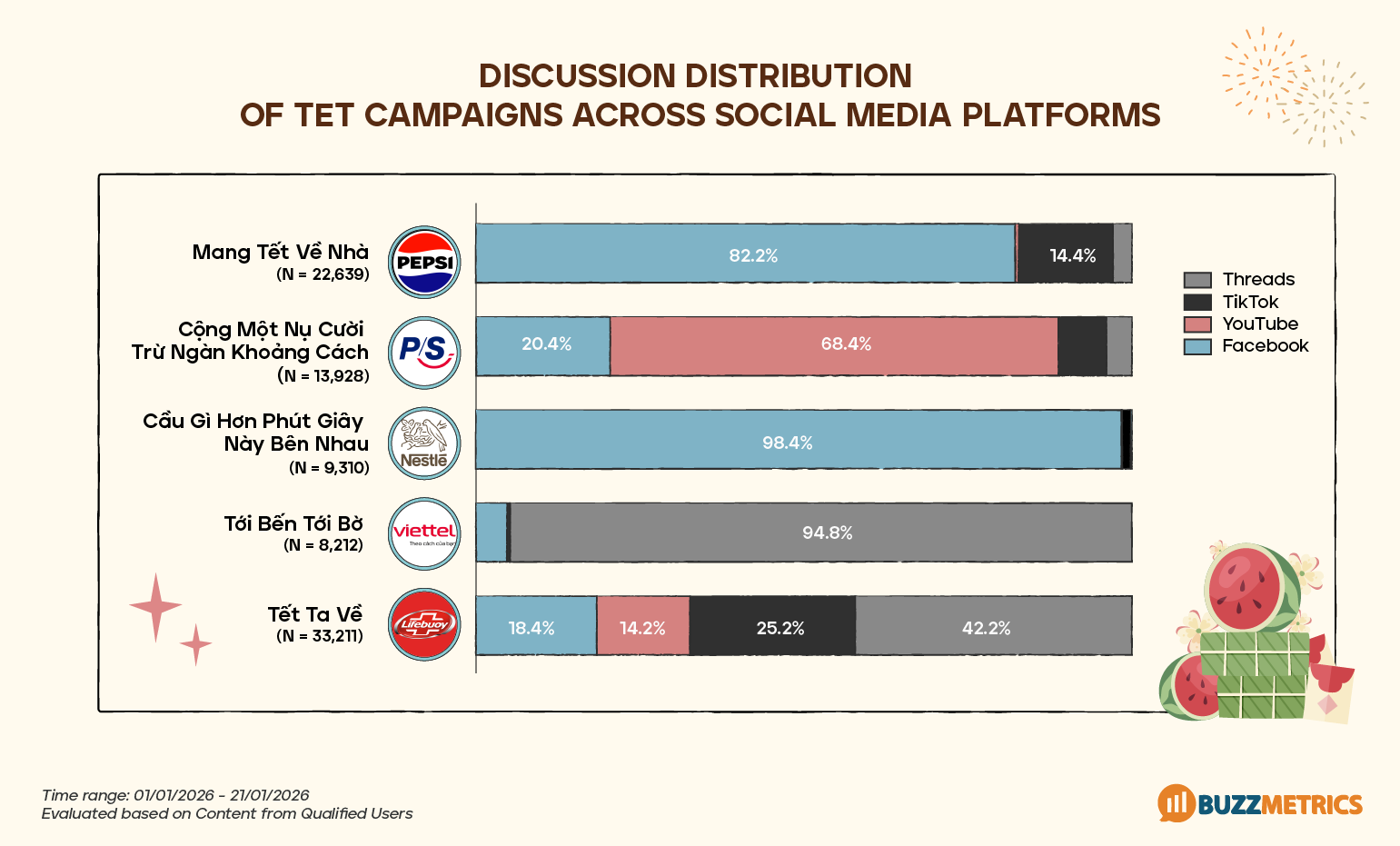
Threads, in terms of noise alone - Buzz Volume, is still a relatively modest platform compared to older platforms like Facebook or TikTok. However, this is currently where the rate of natural discussion is so high, less led, so the “real connection” value that Threads brings to this year's New Year campaigns is undeniable. Examples are Lifebuoy's Tet Tet campaign, the most influential campaign of January 2026, and Viettel's To the Shore campaign - one of the Tet campaigns that received much discussion from users (according to Buzzmetrics statistics as of January 20).

So to speak, Threads has brought a completely different discussion space: more real shares, more truthful images. Viettel's Landing to Shore campaign is a case explored thanks to Threads. It all started with a few single posts, a positive evaluation of the creative and “retrograde” idea of the campaign, and the selection of NSND Tu Long as the main KOL. From there, discussion spread strongly on Threads. 94% of quality user discussions of the To Bun To Shore campaign came from Threads. Another notable case is Lifebuoy's “Tet Tak Tak”, with Threads accounting for almost half of discussions from quality users. Lifebuoy's success comes from the implementation of many meaningful activities with a high level of diligence. In addition to the music of Tet Ta Do, there is also a night of music by Jun Pham and the exhibition Is the Tet Of Someone. Users find themselves in Lifebuoy's narratives and naturally discuss the campaign.
The success of several pioneering campaigns on Threads has sent a signal: There is a “move” to a newer, more in-depth discussion space. This could be the springboard for more groundbreaking, cross-platform Tet 2027 campaigns.

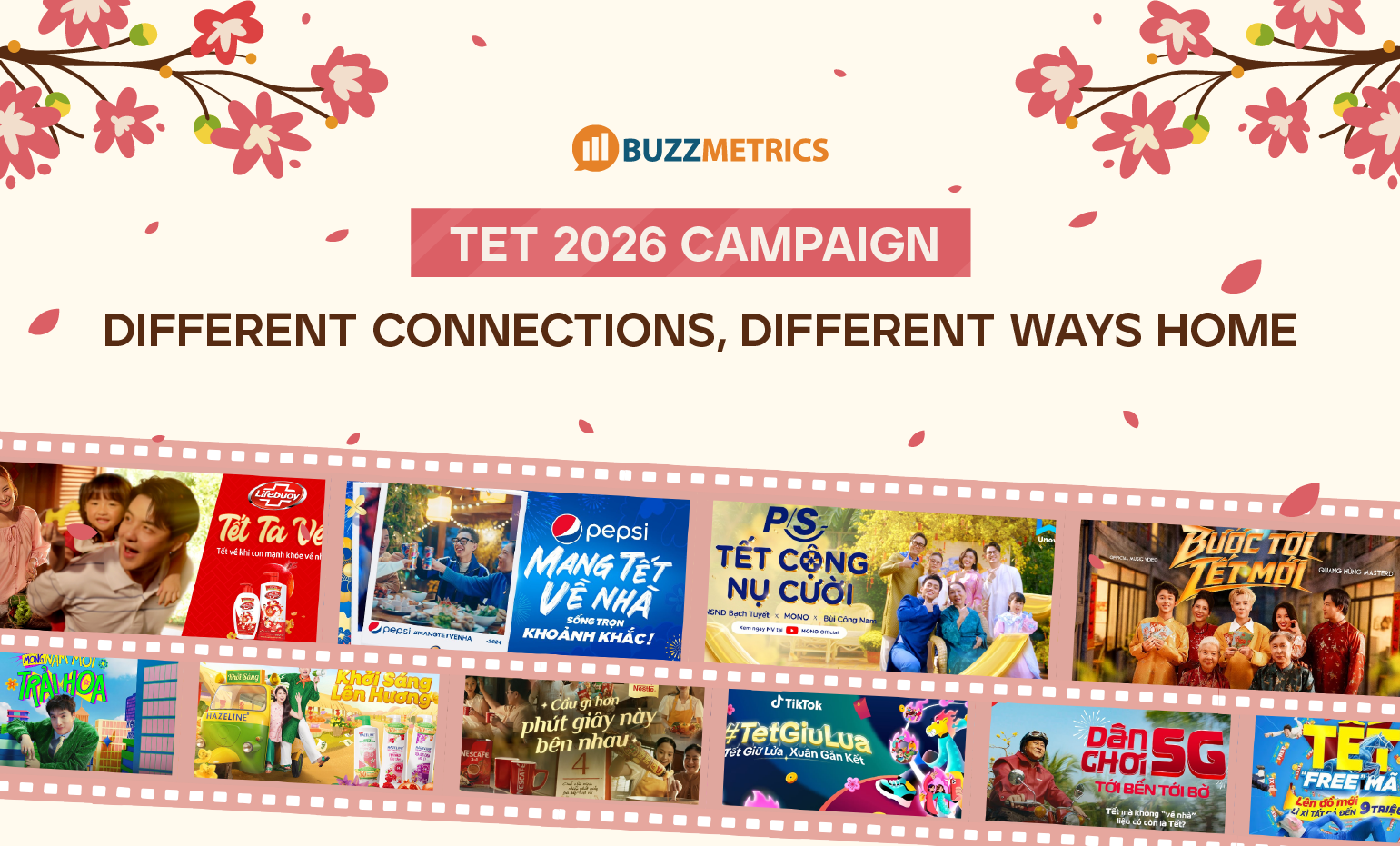
Tet 2026 continues to be a major battleground for brands, where the story of “Coming Home” is no longer told through familiar formulas, but reinvented through diverse and meaningful ways of connecting with audiences. As of January 21 — nearly halfway to Tet — 111 marketing campaigns from 32 industries had already been launched Tet Campaign.
Overall, compared to Buzzmetrics’ previous update on January 8, the market saw more than 30 additional campaigns and six new industries joining the Tet race. Within less than a month, brands also released 24 music videos and short films featuring top artists, reflecting strong investment in the festive season. Although Tet was still weeks away, competition among Tet campaigns had clearly entered its peak stage. Amid the vibrant Tet marketing landscape, Buzzmetrics recognized the importance of highlighting standout campaigns that successfully created “real” connections with consumers.

As mentioned in Buzzmetrics’ previous blog, Content from Qualified Users became the key metric used to evaluate campaign engagement, replacing Buzz Volume as the primary measure of success. The ranking based on Content from Qualified Users revealed that half of the strongest-performing campaigns on social media centered around the “Coming Home” theme, creating genuine emotional connections with audiences. These campaigns included:

Over the years, “Coming Home” and family reunion have gradually become saturated Tet messages because of their familiarity. Consumers constantly talk about returning home for Tet, while brands continue to build campaigns around the same theme. During Tet 2026 alone, 23 campaigns focused on “Coming Home,” making it the third most common message after themes like prosperity and festive joy. So how did these campaigns approach such a familiar topic in a way that still created authentic connections with users?
All five campaigns told very different “Coming Home” stories. Pepsi delivered a more “classic” Tet story through the message “Golden Moments - Bringing Tet Home,” focusing on familiar images of people living far away trying their best to return home and reunite with family around the year-end dinner table.
This classic spirit was further reinforced through Pepsi’s annual CSR program in collaboration with the Ho Chi Minh Communist Youth Union, helping students, workers, and underprivileged people return home for Tet. In every TVC featuring Captain Boy, Pepsi incorporated familiar Tet imagery such as Chung cakes, ancestor altars, and family meals - all coming together to create the “golden moments” of reunion during Tet. The campaign’s momentum was also amplified by a large-scale music festival featuring artists such as Mỹ Tâm, Hòa Minzy, Bray, and Karik. As a result, Content from Qualified Users grew steadily throughout the first 20 days of January.

Meanwhile, Lifebuoy transformed “Coming Home” into an emotional reconnection journey built with remarkable depth and consistency.Instead of focusing on familiar Tet imagery such as fireworks or lucky money, the “Tet Ta Ve” campaign emphasized personal memories and emotional interactions between those returning home and those waiting behind. The campaign began with the “La Tet Cua Mot Ai Do” exhibition - a multisensory experience that guided audiences through nostalgic Tet spaces and encouraged personal reflection.
To sustain this nostalgic atmosphere, Lifebuoy later reintroduced iconic Tet songs from previous campaigns in remixed versions, maintaining audience engagement before eventually reaching a new discussion peak with the launch of the “Tet Ta Ve” MV. This was clearly reflected in the campaign’s Content from Qualified Users trend: conversations remained active during the first half of January thanks to the exhibition and smaller Tet stories, before exploding after the MV release.
Nestlé approached Tet in a much simpler yet still impactful way. Through the meaningful message, “Tet moments together are limited, which makes every present moment even more precious,” Nestlé partnered with Kenh14 and aFamily to launch the “Wishlist Ngay Luc Nay - Cau Gi Hon Phut Giay Nay Ben Nhau” contest. Another highlight was the “Tet Calendar for Today” - a minimalist calendar without dates, displaying only the word “Today” as a reminder for people to cherish the present moment of togetherness. Aside from support from major community pages, the campaign did not rely heavily on KOLs.
The campaigns “Cong Mot Nu Cuoi Tru Ngan Khoang Cach” by P/S and “Toi Ben Toi Bo” by Viettel brought fresh perspectives to the “Coming Home” theme. For P/S, enjoying reunion moments required overcoming not only physical distance, but also generational gaps. This message was reflected in the MV “Tet Cong Nu Cuoi,” featuring MONO, Bạch Tuyết, and Bùi Công Nam, blending modern pop music with traditional cải lương performance. The campaign also introduced a Gemini-powered microsite that helped families experience Tet across different generations.
Meanwhile, Viettel’s “Toi Ben Toi Bo” told a completely reversed “coming home” story. During Tet, people are often too busy to return home on time - so what if the family came to them instead? This unconventional idea was expressed through the message “If I can’t come home, then home will come to me,” leading to the journey of Meritorious Artist Tự Long in the short film “Dan Choi 5G - Toi Ben Toi Bo.” Although the short film was the campaign’s only major activity, its unique storytelling approach generated strong organic discussions. The campaign reached two discussion peaks: one during the film launch, and another fueled by organic user conversations on Threads.
This year’s standout “Coming Home” campaigns proved that even an old message can still resonate strongly when paired with fresh storytelling and new perspectives. Whether emotional like Lifebuoy, classic like Pepsi, culturally blended like P/S, simple like Nestlé, or unconventional like Viettel, each campaign found its own meaningful way to connect with audiences during Tet 2026. More importantly, these campaigns also reflected a larger transformation in the social media landscape: marketers now have far more platform choices for storytelling.
Five years ago, Facebook dominated both campaign launches and viral distribution. Most discussions from every campaign primarily came from Facebook. However, among this year’s standout campaigns, platform strategies became much more diversified. Nestlé’s minigame activities and Pepsi’s CSR initiatives still relied heavily on Facebook. Lifebuoy’s emotionally driven storytelling leaned more toward TikTok and Threads. P/S focused strongly on YouTube, while Viettel became the only campaign primarily driven by Threads. On Threads, users did more than simply watch Viettel’s campaign - many actively analyzed its message and praised its “out-of-the-box” storytelling style. As conversations spread organically, the campaign went viral on Threads with an overwhelming share of Content from Qualified Users.
Overall, with the rise of Threads and TikTok alongside Facebook, marketers now have more ways to tell their stories. At the same time, they must place even greater emphasis on storytelling quality to ensure Tet campaigns create meaningful impact. This shift reflects the inevitable evolution of Social Media Marketing - moving away from the “the louder, the better” era toward an era of “real people, real connections.”
The Lunar New Year (Tet) season has always been the most fiercely competitive "battleground" of the year for Vietnamese marketers, where brands pour their full resources into capturing the minds and hearts of consumers through the Tet campaign. As no exception, the upcoming Tet 2026 is forecasted to witness a race more intense and cutthroat than ever before.
As previously noted by Buzzmetrics, even before the first week of 2026 had passed, nearly 60 Tet campaigns had already been launched. In just the following 7 days (from January 5th to 12th), the market witnessed a quantum leap:
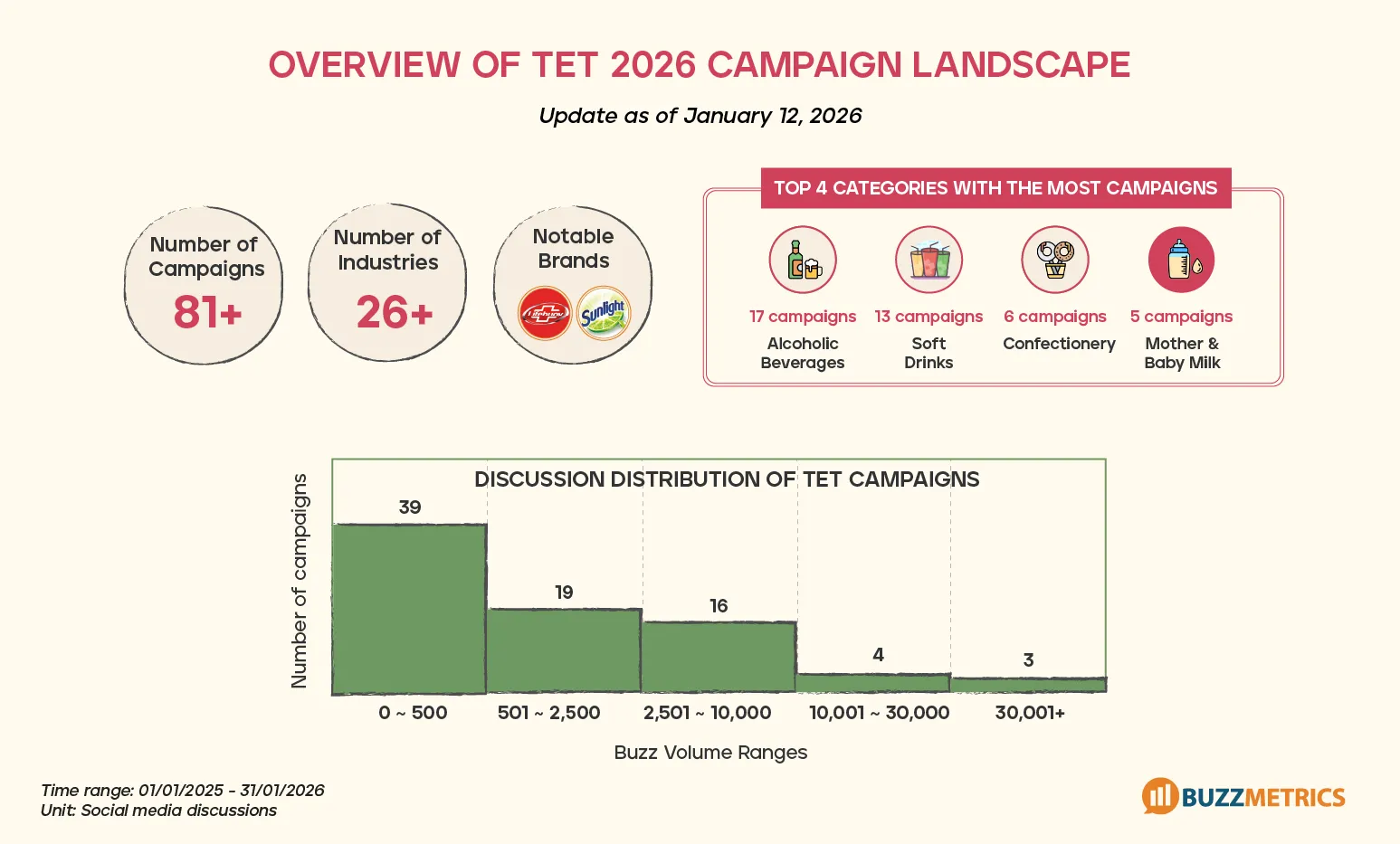
Campaigns are increasingly differentiating in terms of discussion volume thresholds, reflecting intense competition. Whereas last week the top campaign only reached around 10,000 buzz, the leading group has now surged powerfully into the range of 30,000 to 50,000 buzz.
As the Tet race heats up by the hour, the most pressing question is no longer “How many discussions do we have?” but rather “How many of those discussions are truly meaningful?” In this context, Qualified Metrics - Buzzmetrics’ system of quality-based indicators- has become the guiding compass for uncovering real effectiveness behind explosive numbers.
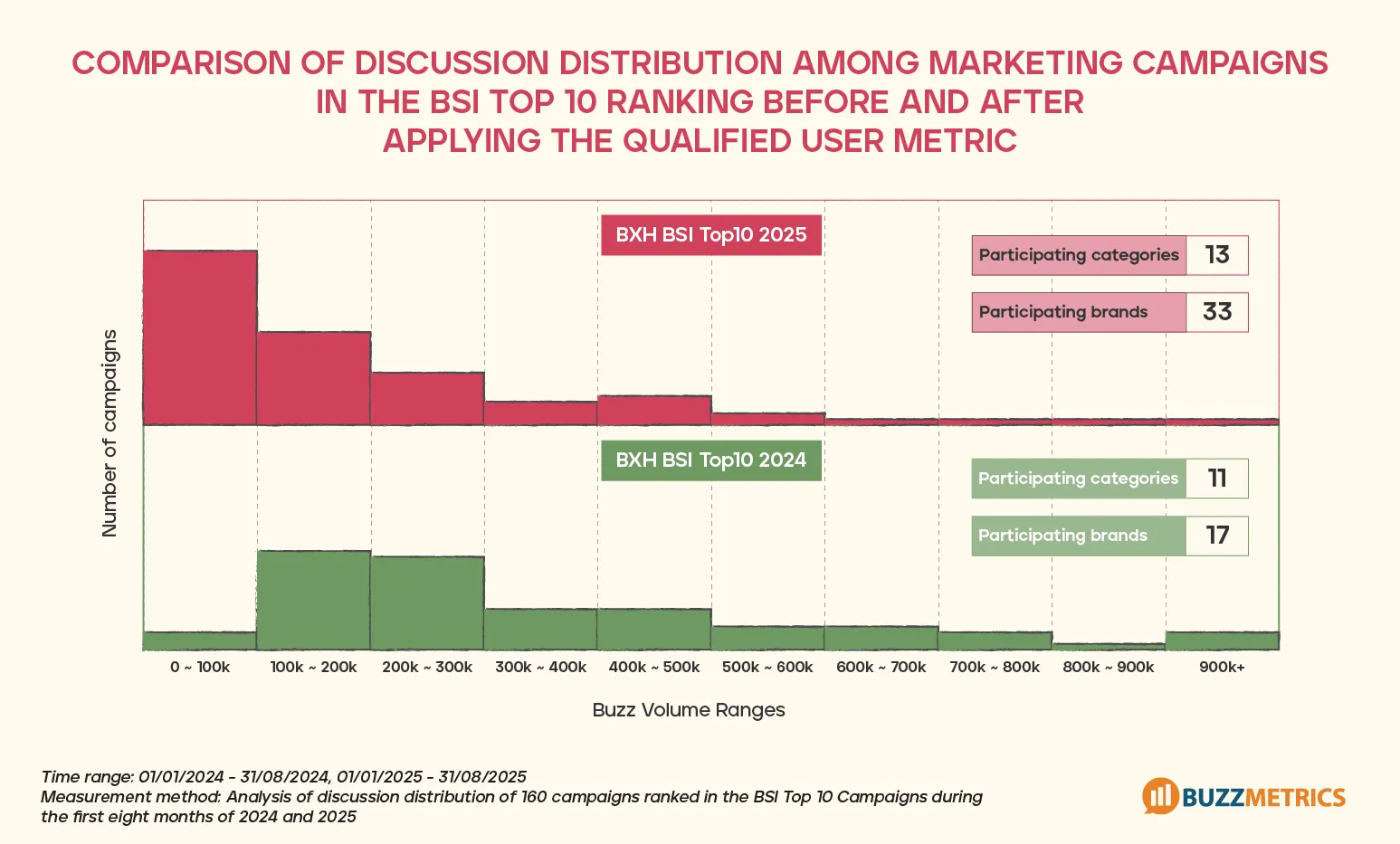
Tet 2025 marked the first season Buzzmetrics applied Qualified Metrics in campaign evaluation, leading to what can be described as a “positive disruption.” Campaign rankings before and after the application shifted significantly. Campaigns that once appeared dominant in terms of Buzz Volume suddenly dropped, replaced by less noisy campaigns with higher-quality discussions and more valuable user participation.
So, what exactly are Qualified Metrics? And how do they reshape the way campaign impact is measured? Let’s explore together in this article.
In the early days of social media analysis, one commonly referenced metric was Total Audience- the number of users generating discussions. This metric helped brands roughly estimate campaign reach. However, Total Audience fails to account for “abnormal” accounts- those created in bulk or operating at unnatural posting frequencies, often sharing content mechanically. This posed a major challenge in campaign effectiveness evaluation.
Recognizing this issue, Qualified User emerged as a smart filtering layer pioneered by Buzzmetrics. A user is considered Qualified only when they meet strict criteria:
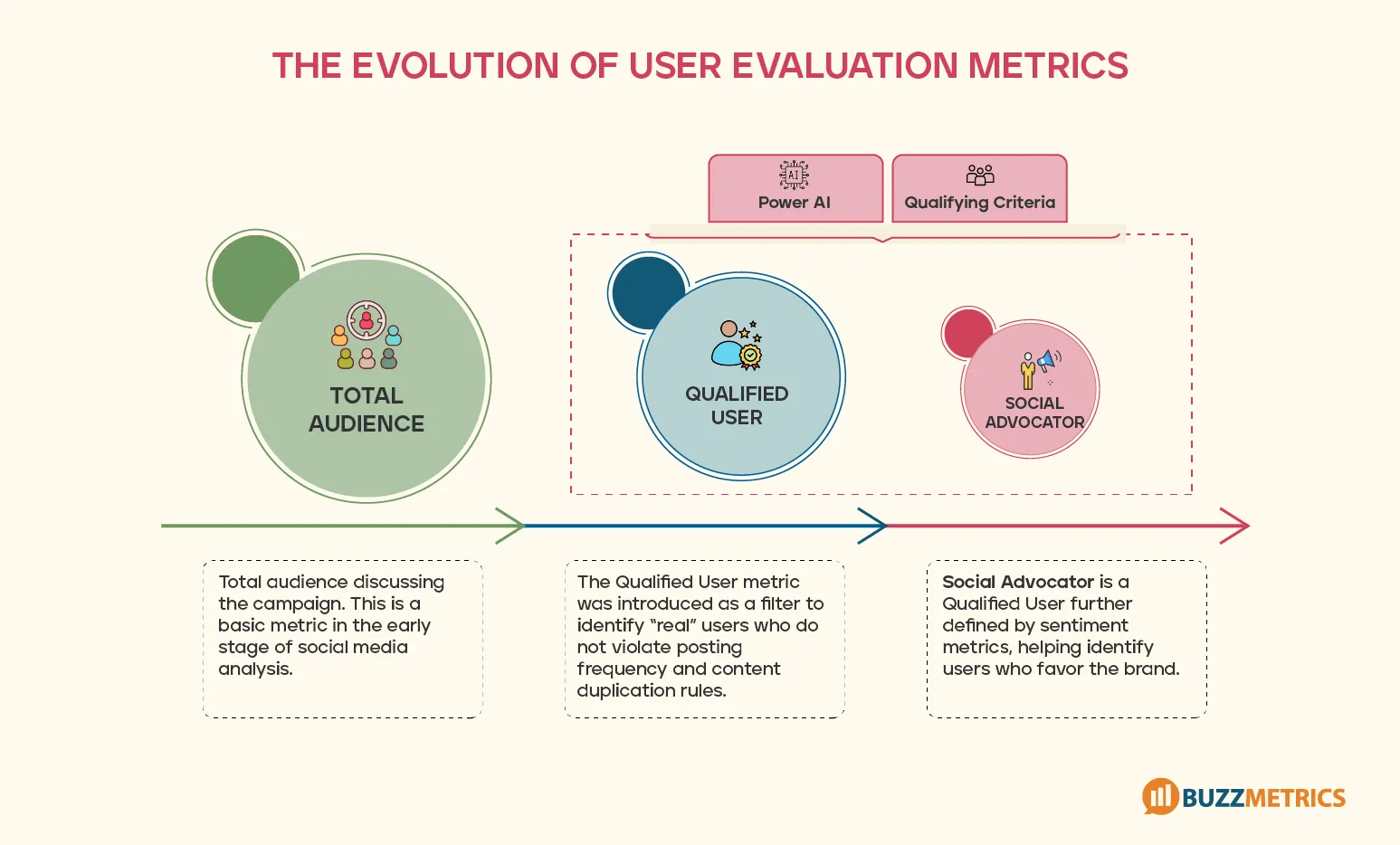
Identifying Qualified Users within a complex social environment marks a significant advancement in data analysis. It helps eliminate noise and refocus efforts on user groups with real conversion potential. When a Qualified User not only discusses a campaign but also expresses preference, support, and voluntarily shares positive brand-related content, they become a Social Advocator. This is the most valuable asset of any Tet campaign, as their voice carries far more weight than conventional advertising posts.
Qualified User is not just another data point. In practice, it functions as an underlying “operating system” that influences and constrains other metrics, forming the broader Qualified Metrics ecosystem.
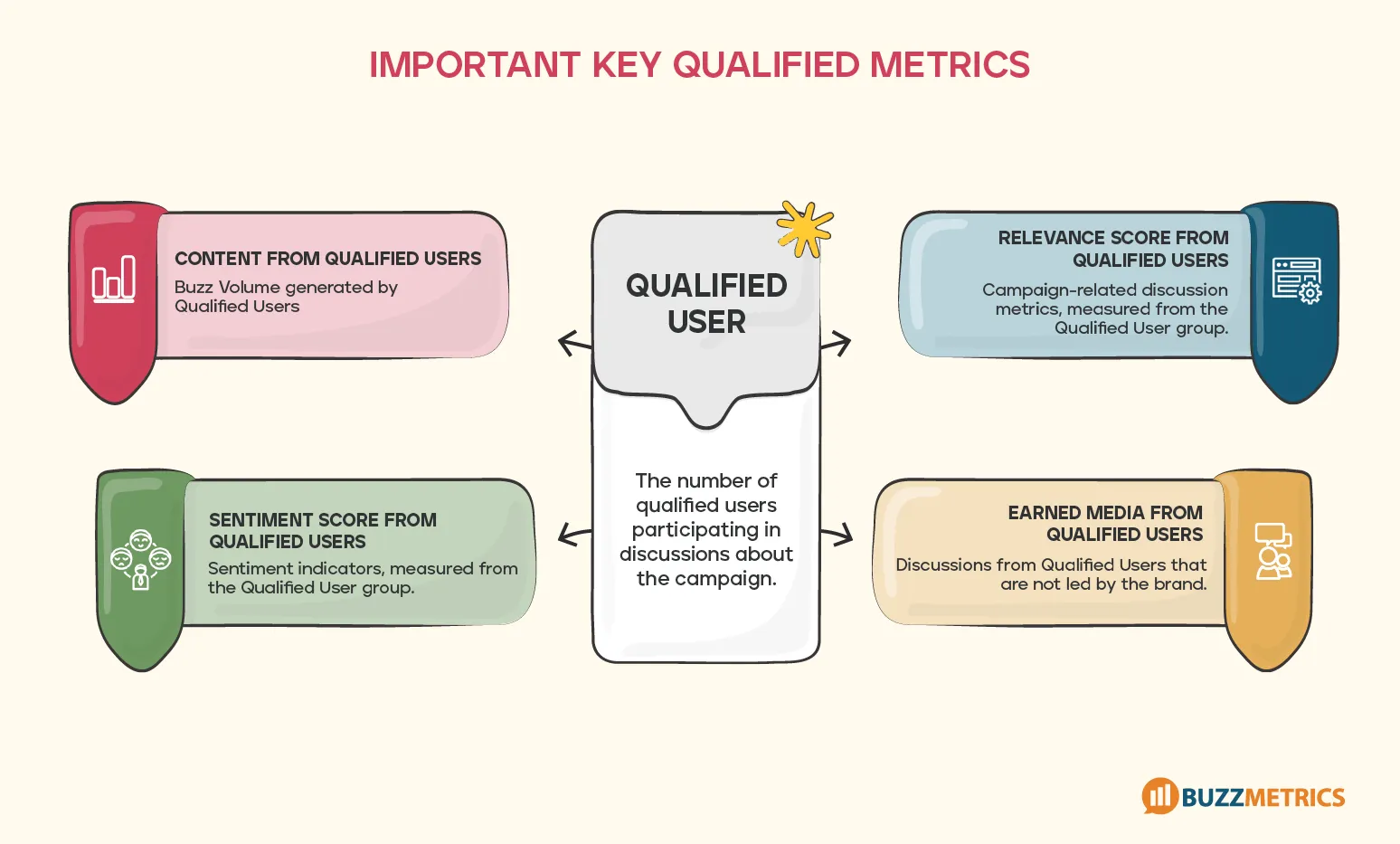
When Qualified User is used as the foundation, the following key metrics are directly impacted:
So how have Qualified Metrics tangibly influenced campaign evaluation? Looking at the long-term picture across the first eight months of 2025, since Qualified Metrics were applied to the BSI Top 10 Campaigns ranking, the marketing landscape has become more dynamic than ever. New categories and smaller brands with creative approaches have appeared in the BSI Top10. This provides well-deserved recognition for campaigns that generate "real engagement, real buzz."
It encourages Agencies and Brands to focus on creative content rather than an arms race based on "artificial volume." This is also the basis for Buzzmetrics to continue applying Qualified Metrics to evaluate Tet 2026 campaigns. It can be said that Qualified Metrics are no longer an option but have become a mandatory requirement in social media conversation analysis.
Although Tet campaigns 2026 have only reached the halfway mark, the market is already vibrant and highly creative. With rapid growth in both campaign volume and discussion intensity, evaluation based on Qualified Metrics is no longer a luxury-it is a necessity. Qualified Metrics not only help protect brand value but also enable real-time campaign optimization. Don’t let inflated numbers drown out the authentic voice of real users.
Nearly 24 million discussions were recorded in just 10 days, from December 20, 2025 to January 5, 2026 - even though Tet is still more than a month away. This once again confirms the undeniable importance of Tet to Vietnamese consumers. Brands across multiple industries have already begun gearing up and launching their Tet campaigns. In this context, let’s take a closer look with Buzzmetrics at the early-stage Tet conversations at the beginning of 2026.
Discussions around Tet surged rapidly after the first day of 2026, consistently exceeding one million mentions per day. Familiar social media platforms such as Facebook and TikTok continue to be the main hubs for conversations about Tet preparations. A notable difference in 2026, however, is the emergence of Threads. Although its discussion volume remains relatively modest compared to Facebook and TikTok, Threads stands out as a space where users share deeper, more reflective thoughts-opening up opportunities for richer insights into consumer behavior.
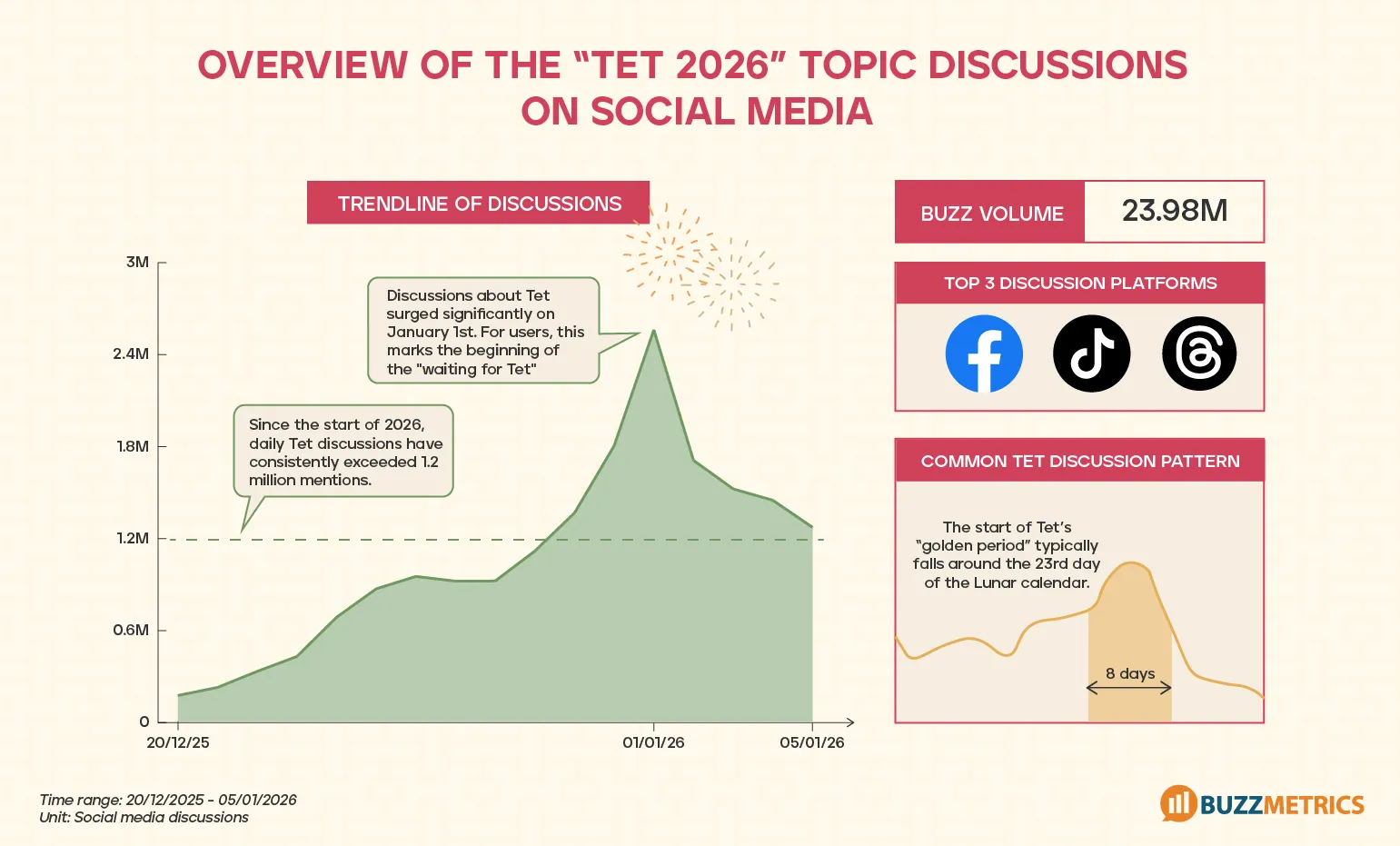
Based on observations from previous years, Buzzmetrics has found that the “golden period”-when consumer interest in Tet peaks-typically begins around the 22nd or 23rd day of the Lunar December and lasts for about a week. From now until then, Tet-related discussions are expected to rise steadily, peaking just before Lunar New Year’s Eve. This means that while Tet has already generated nearly 24 million discussions, the momentum is far from slowing down. The coming weeks will mark an explosive phase for Tet conversations.
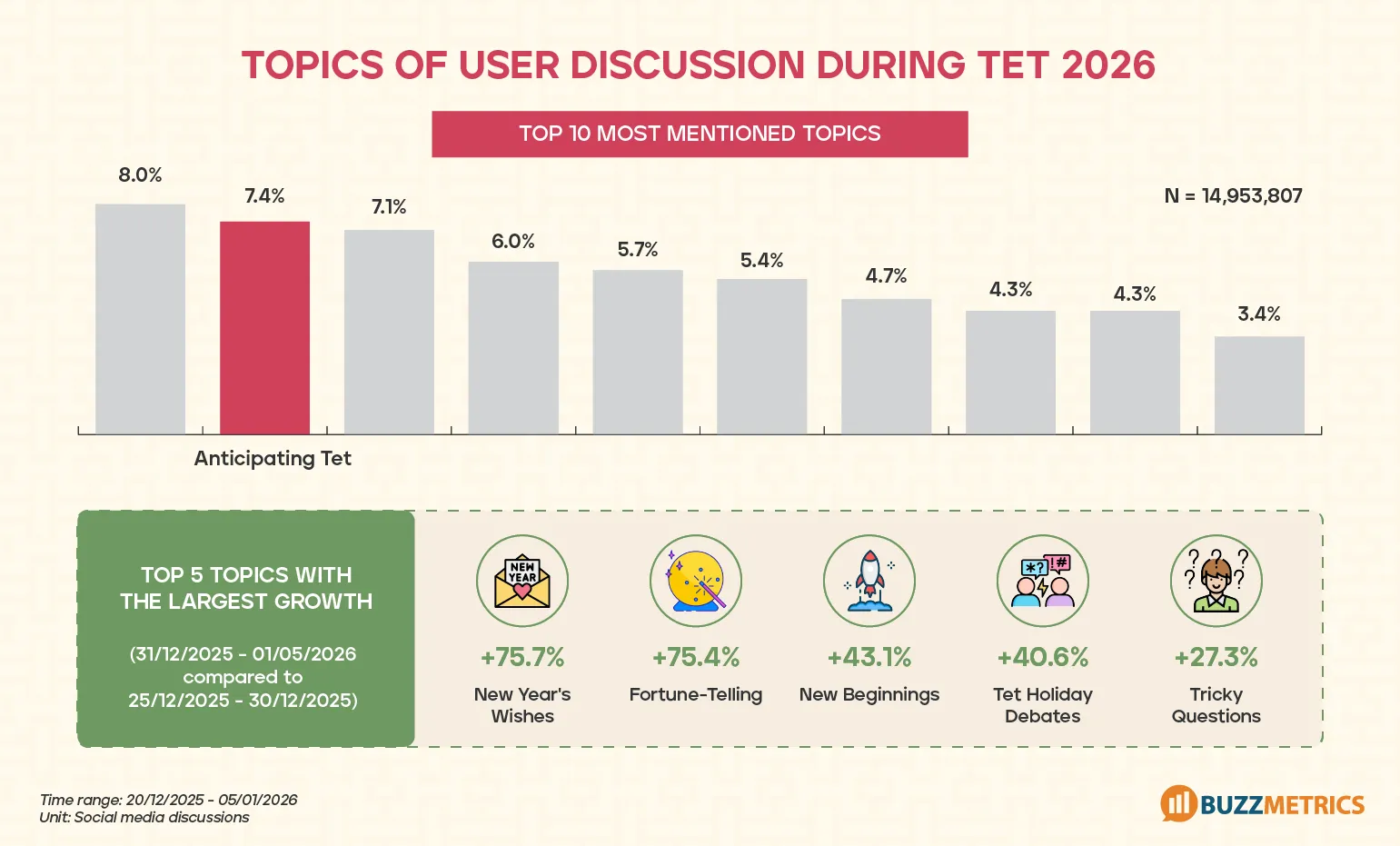
Looking at discussion themes, “anticipating Tet” has climbed to become the second most prominent topic. This reflects a common consumer mindset: regardless of whether Lunar New Year comes early or late, once the Gregorian New Year ends, consumers immediately switch into “Tet anticipation mode.” Even with more than a month to go, users are already counting down to Tet. In the near future, Tet-related topics are certain to continue fluctuating strongly.
Among the fast-growing topics, debates surrounding Tet traditions stand out. This year, discussions about celebrating Tet with the husband’s family or the wife’s family have spread widely across social media platforms. A smaller group of users has also raised the idea of replacing the Lunar New Year with the Gregorian New Year, sparking mixed reactions. Fortune-telling remains a “hot” Tet-related tradition, especially as modern users show growing interest in spiritual topics. Over the past year, “Year Number 9” was among the most notable social media keywords. Moving into 2026, users are once again curious about what kind of year lies ahead.
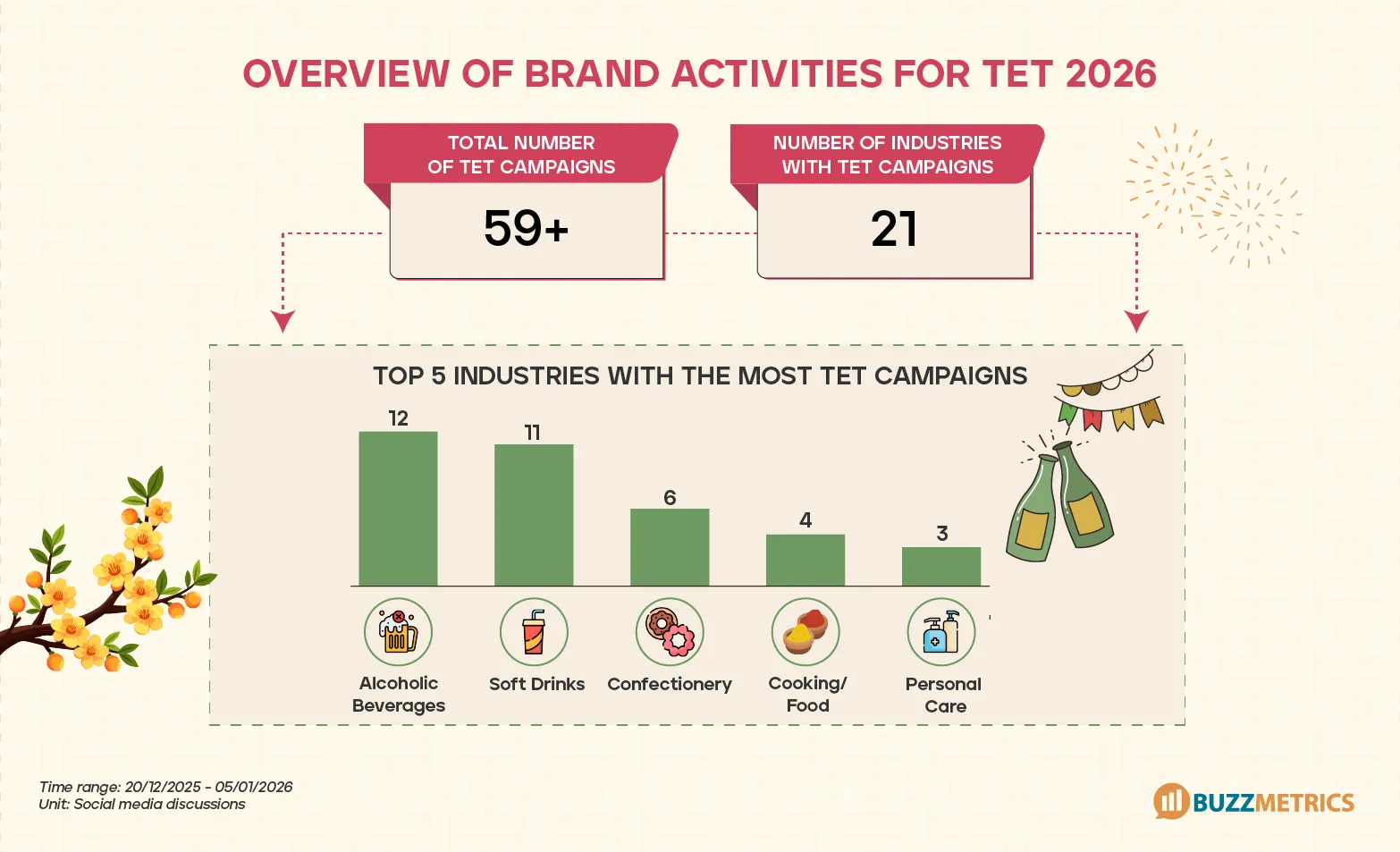
For brands, the Tet season has already become vibrant right from the preparation phase. Although Tet 2026 is still more than a month away, 59 Tet campaigns across 21 industries have already been launched-equivalent to nearly half of the total number of Tet campaigns in 2024. Leading in campaign volume are the familiar categories of alcoholic beverages and soft drinks. Meanwhile, the Dairy category-one of the most active industries in 2024-appears to be in a “waiting mode,” likely preparing for more impactful launches later in the season.
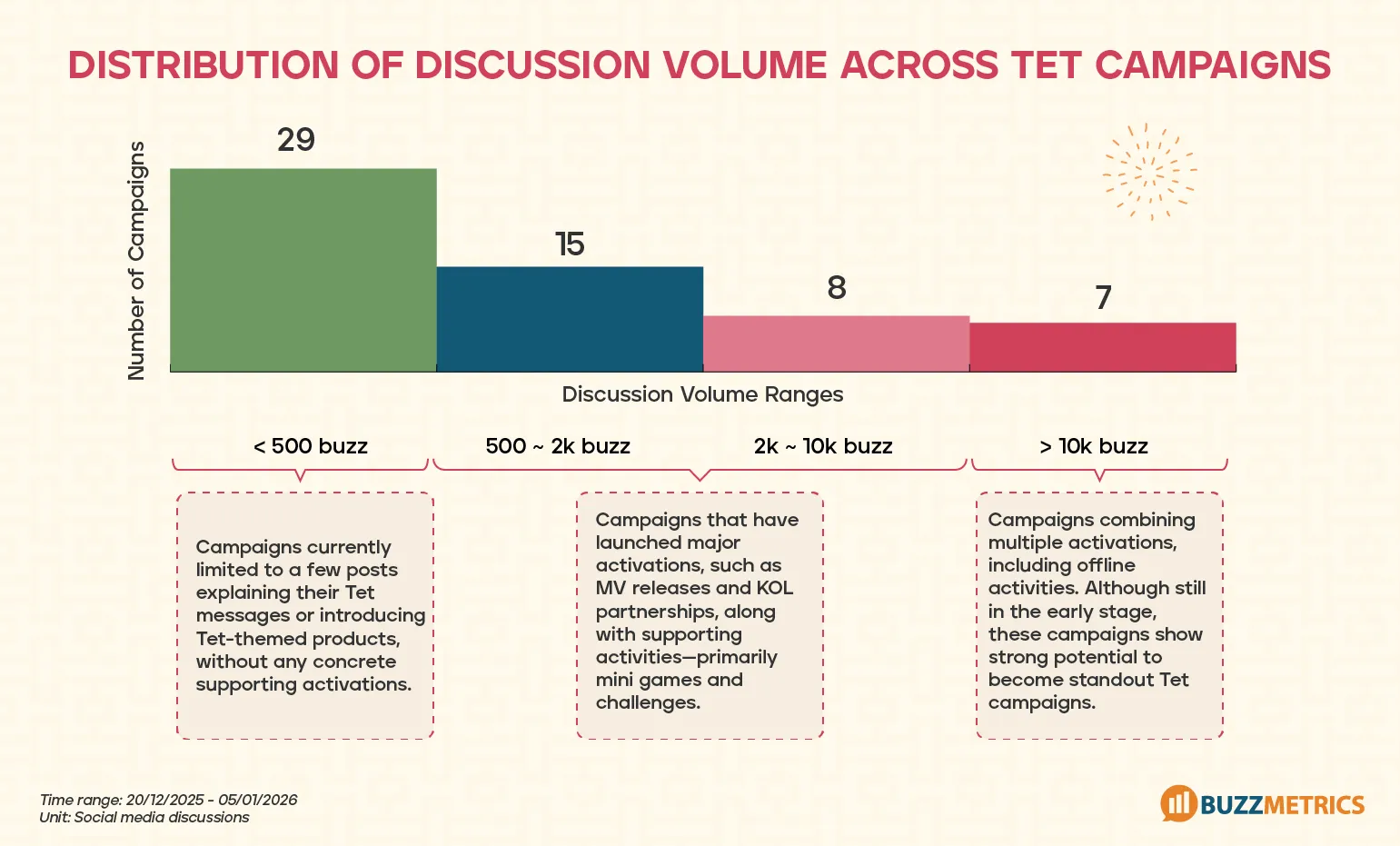
A deeper analysis of discussion distribution across Tet campaigns shows that most campaigns currently generate relatively modest buzz (under 1,000 mentions). These campaigns typically include a limited number of posts explaining Tet messages or introducing new products, without yet rolling out major activations. Some campaigns have begun deploying larger-scale activities such as music video launches and KOL collaborations, generating more promising discussion volumes and building momentum for the next phase. Campaigns that surpass 10,000 mentions often combine online and offline activities in a well-balanced way.
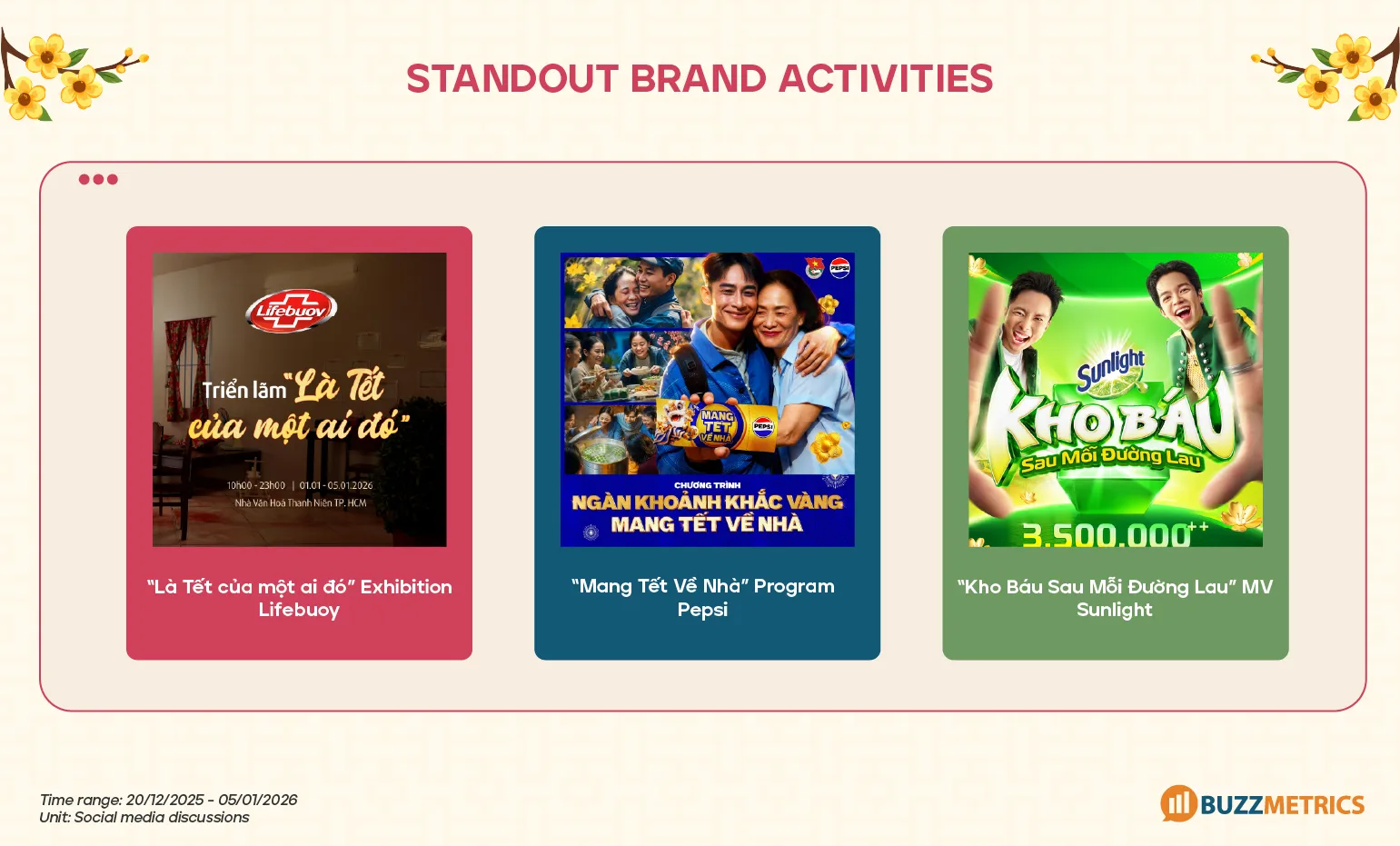
A notable example is Lifebuoy with its exhibition “Là Tết của một ai đó”. Designed as an emotional journey of children living away from home, the exhibition guided visitors through thoughtfully curated spaces that evoked the longing of those who wish to return and those who are waiting. The event featured well-known figures such as Dong Nhi, Ong Cao Thang, and Huynh Lap. The offline experience was amplified on social media through heartfelt sharing from attendees. “Là Tết của một ai đó” serves as a strong runway for Lifebuoy to continue its 2026 reunion narrative.
The “Mang Tết Về Nhà” campaign, co-organized by Pepsi and the Ho Chi Minh Communist Youth Union, has also received positive feedback. Now in its fifth year, the campaign aims to support students and individuals in difficult circumstances in returning home to celebrate Tet.
Meanwhile, Sunlight has captured attention with its creatively launched opening MV “Kho Báu Sau Mỗi Đường Lau”, featuring (S)TRONG Trong Hieu and Rhymastic. The MV revisits the familiar Tet theme of house cleaning, set to the melody of “Kho Báu”, one of the most popular songs of 2026. The video garnered over 3.5 million views within the first 24 hours, making it the most prominent Tet MV to date.
Overall, Tet 2026 once again proves that it is not only a traditional holiday but also a peak season for social media engagement, offering significant opportunities for brands to tap into consumer insights, optimize content, and execute impactful campaigns. This year, brands will need to pay closer attention to Threads, alongside TikTok and Facebook, when monitoring and analyzing consumer behavior.
Based on current brand activity, Buzzmetrics forecasts an intensely competitive Tet season ahead. The number of Tet campaigns is certainly unlikely to stop at 59.
Social Listening is a form of market research based on social media discussions, helping to analyze brand health, campaigns, special events, and more...
Along with the development of social networks, Social Listening is also growing in application capabilities. If in the past, Social Listening was only about collecting social media data, today data collection is only a part of Social Listening. Measuring buzz volume or sentiment is no longer the only function of Social Listening. In the context of this article, let's look at old questions through a new lens: What is social listening and what role does it play in social media marketing?
Social Listening is a form of market research that analyzes online user discussions across social media platforms. It involves the collection and analysis of conversations from various online platforms, including social media, forums, blogs, news sites, and review websites. Unlike traditional research methods, Social Listening works primarily with unstructured data, offering businesses real-time feedback from diverse users across different online platforms.
Typically, a Social Listening process follows these steps:
- Step 1: Build an analysis plan
Researchers begin by defining the context and research objectives, then set the key questions to be addressed.
- Step 2: Data collection
Using Social Listening tools, researchers gather data based on keywords from all social platforms, ensuring an accurate and comprehensive understanding of trends and industry data.
- Step 3: Data filtering and analysis
After collecting data, researchers filter out irrelevant or misleading information to ensure accuracy. Data is processed through AI systems and human verification to find potential insights.
- Step 4: Data visualization and reporting
Finally, the results are compiled into a complete report with visualized data for easier understanding and decision-making.
Social Listening data sources are not limited to major social media platforms like Facebook, Instagram, TikTok, or Threads. They also cover any medium that allows multi-way interaction, including forums, e-newspapers (comment sections), blogs, and e-commerce review sections.
(A) API Data Collection
This method connects Social Listening tools to the APIs (Application Programming Interfaces) of social networks to retrieve posts containing specific keywords.
- Advantages: Allows access to all data from the network, including personal pages.
- Disadvantages: API reliability may fluctuate, leading to incomplete or inconsistent data over time.
(B) Site Data Collection
This method involves accessing listed sites to collect data without disrupting the websites, either by manual or automatic data gathering processes.
- Advantages: Ensures 100% of data on the site is collected.
- Disadvantages: Certain issues, like site changes or blocking, may cause temporary data shortages.
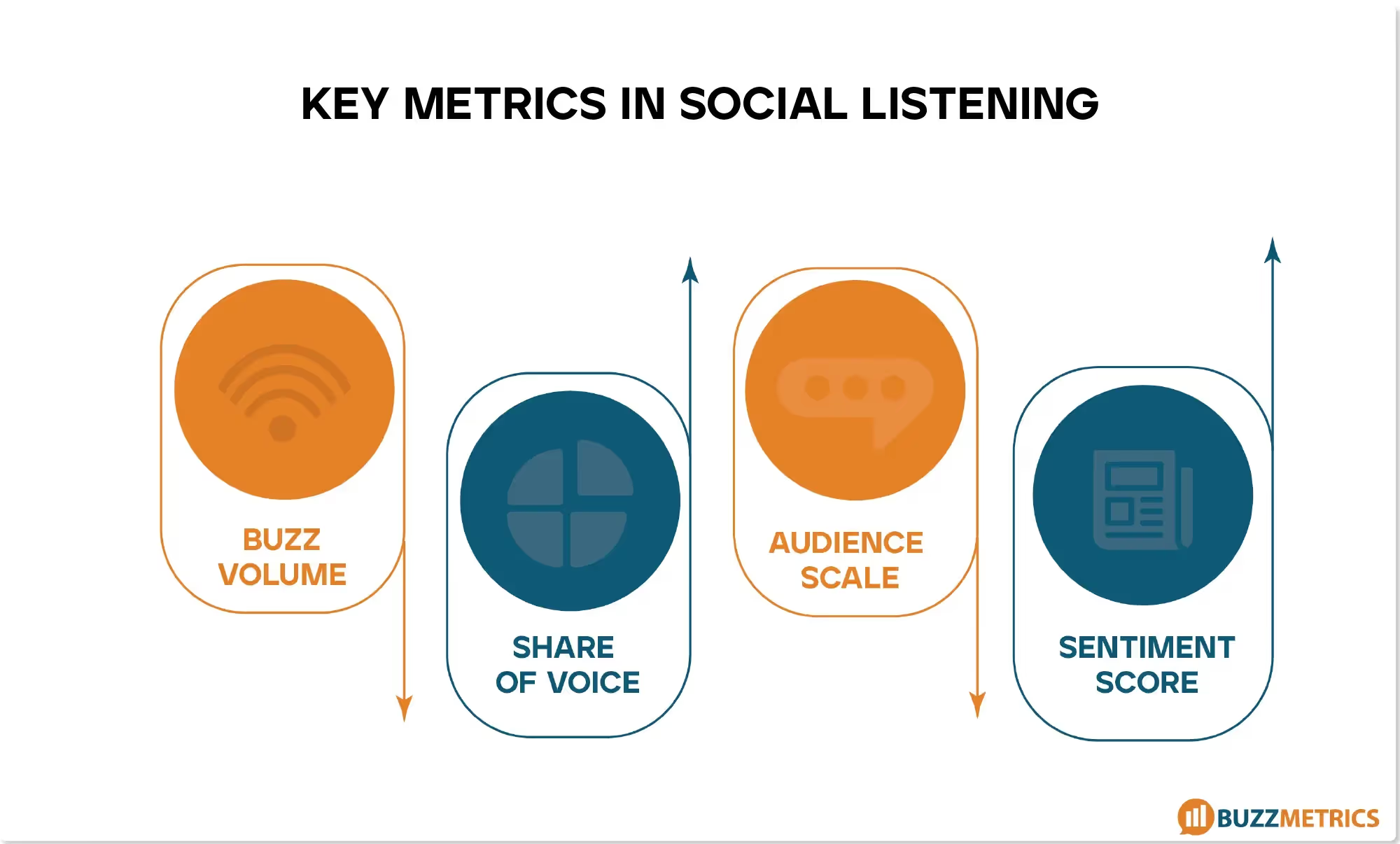
When conducting research via Social Listening, marketers should focus on key metrics to gain a comprehensive view of the research landscape and measure the effectiveness of their Social Media Marketing strategies:
- Buzz Volume: The number of discussions (posts, comments, or shares) about a specific topic.
- Share of Voice (SOV): Compares the discussion volume of a brand against competitors.
- Audience Scale: The number of individuals participating in discussions about a topic.
- Sentiment Score: Indicates users' emotions toward a topic, calculated by comparing positive and negative discussions.
Initially, Social Listening was seen by many marketers as a purely measurement tool, providing basic metrics about campaigns or brands in comparison with competitors (such as discussion volume, participant count, sentiment scores, etc.). However, over time, social media has expanded significantly in scale. Users have become more familiar with Digital Transformation, sharing more than ever, and social media trends are emerging increasingly. As a result, the scope of social media data has broadened, offering a wealth of potential information to support Social Media Marketing strategies. Consequently, Social Listening has also evolved to gather data across various platforms and meet diverse research needs from marketers.
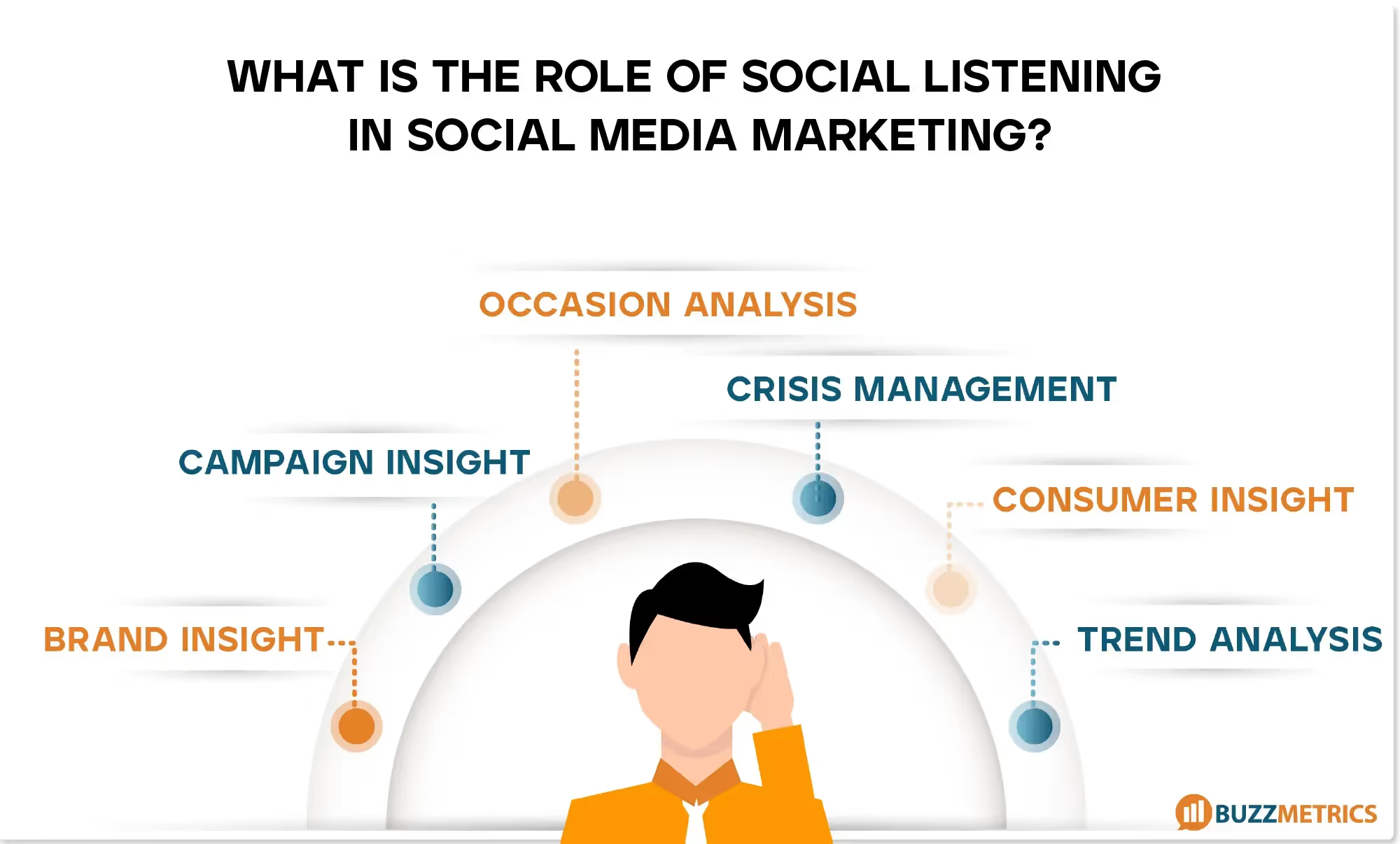
For each research focus, marketers can apply Social Listening to a range of different areas. Typically, marketers can use Social Listening for three main research directions: (1) Insight Understanding, (2) Campaign Tracking, (3) Crisis Management.
This research can provide a comprehensive overview of a specific industry, including e-commerce performance, brand image identification, and opportunities for differentiation. It also outlines the target audience's profile, capturing public attitudes and usage toward products/brands/industries.
a. Industry Competitive Landscape:
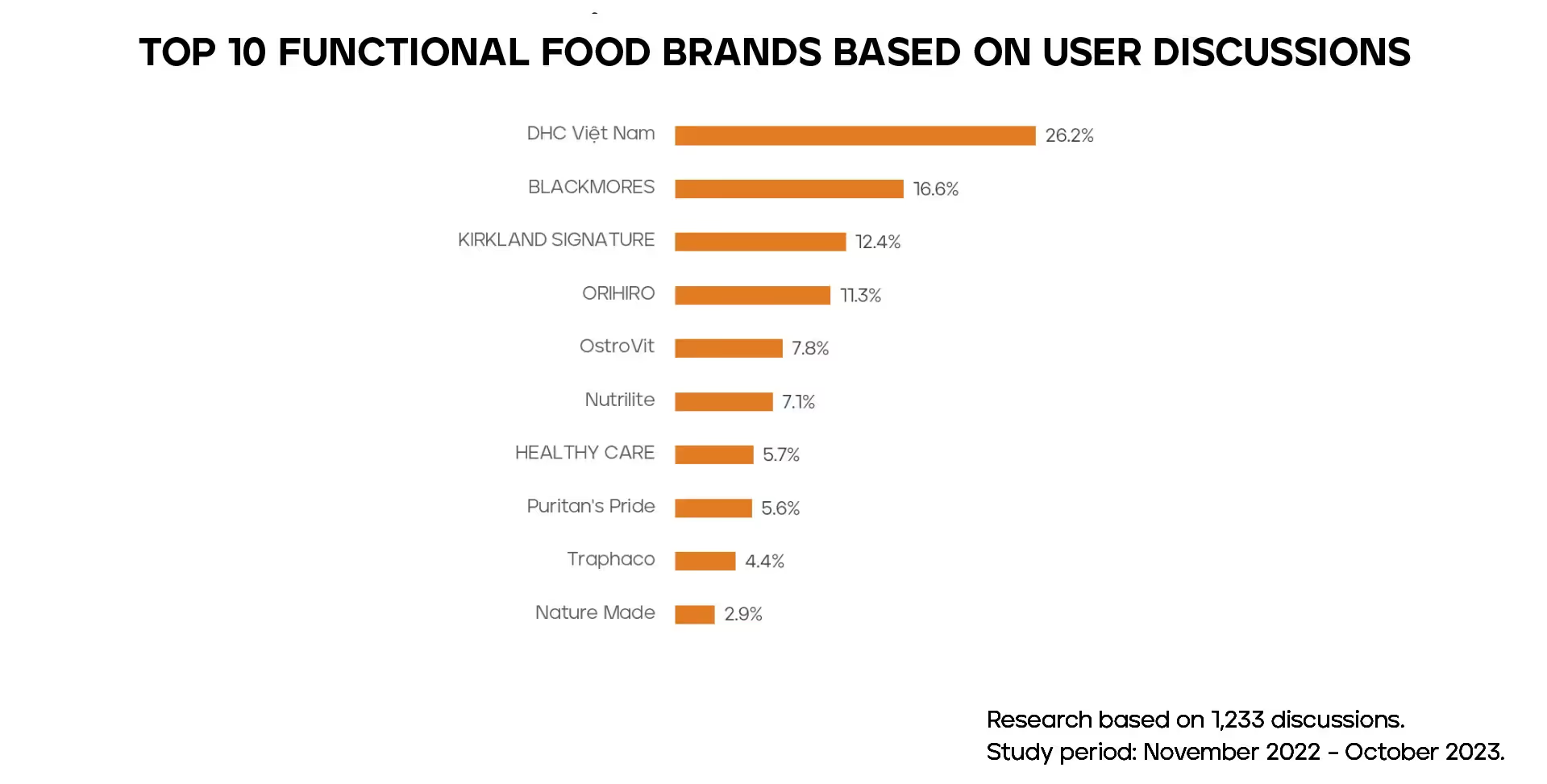
For instance, the chart below shows the most-discussed functional food brands over a certain period. From this, brands can identify their competitors, understand their position in the competitive landscape, and aim for top-of-mind awareness among consumers. Moreover, by quoting user discussions, researchers can pinpoint issues regarding public perception of both the brand and its competitors. This allows the brand to compare, recognize problems, and take corrective action if needed.
→ Read more: Exploring Insights in the Functional Food Industry: Challenges and Opportunities in the Digital Era
b. Brand Image and Differentiation:
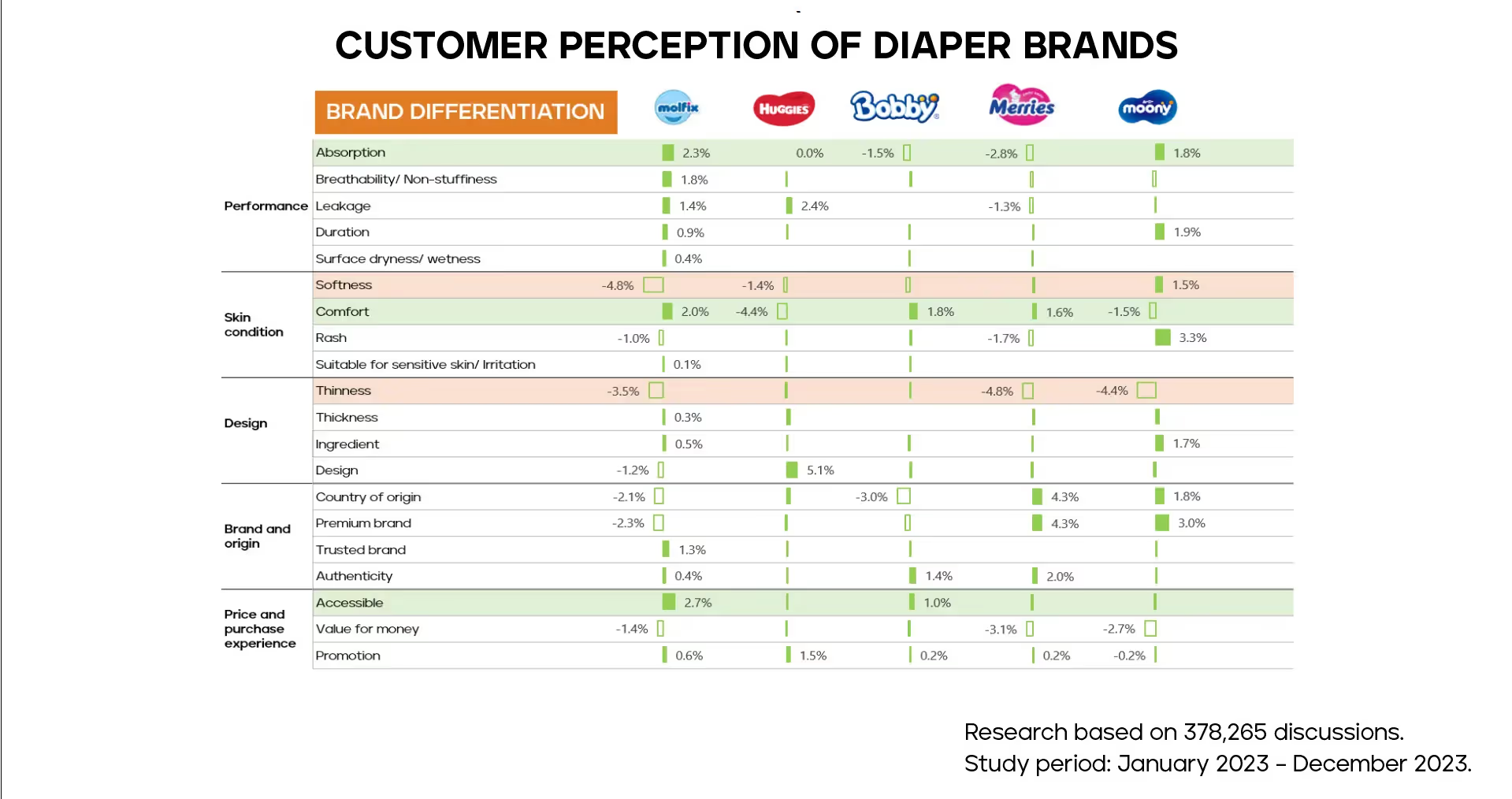
An example of Buzzmetrics research on leading diaper brands paints a detailed picture of brand differentiation. Compared to other brands, Molfix’s product performs exceptionally well in absorbency. However, aspects like softness and thinness received negative feedback. Molfix’s branding team can also monitor current customer perceptions of competitors and identify areas for improvement.
c. Usage and Attitude Research (UnA):
UnA research focuses on consumer discussions and plays a key role in unveiling the consumer landscape of an industry. It addresses key questions like:
- Users' interest levels in the product/brand on social media
- Awareness, usage, and consumer behavior displayed on social platforms
- Motivations and barriers to product/brand consumption
- General satisfaction/dissatisfaction with current products/services
- Users’ needs, unmet demands, or general expectations
d. Target Audience Segmentation:
In some cases, brands aim to understand consumers not just from a product buyer perspective but from a broader context that includes their lifestyle and habits. Social Listening can support brands in achieving this.
For instance, analyzing the most-discussed topics within Gen Alpha revealed that "love" was the top theme, surpassing even "education" and "games." This insight shows that to engage Gen Alpha, brands should consider using "love" as a central theme to attract attention and foster interaction.
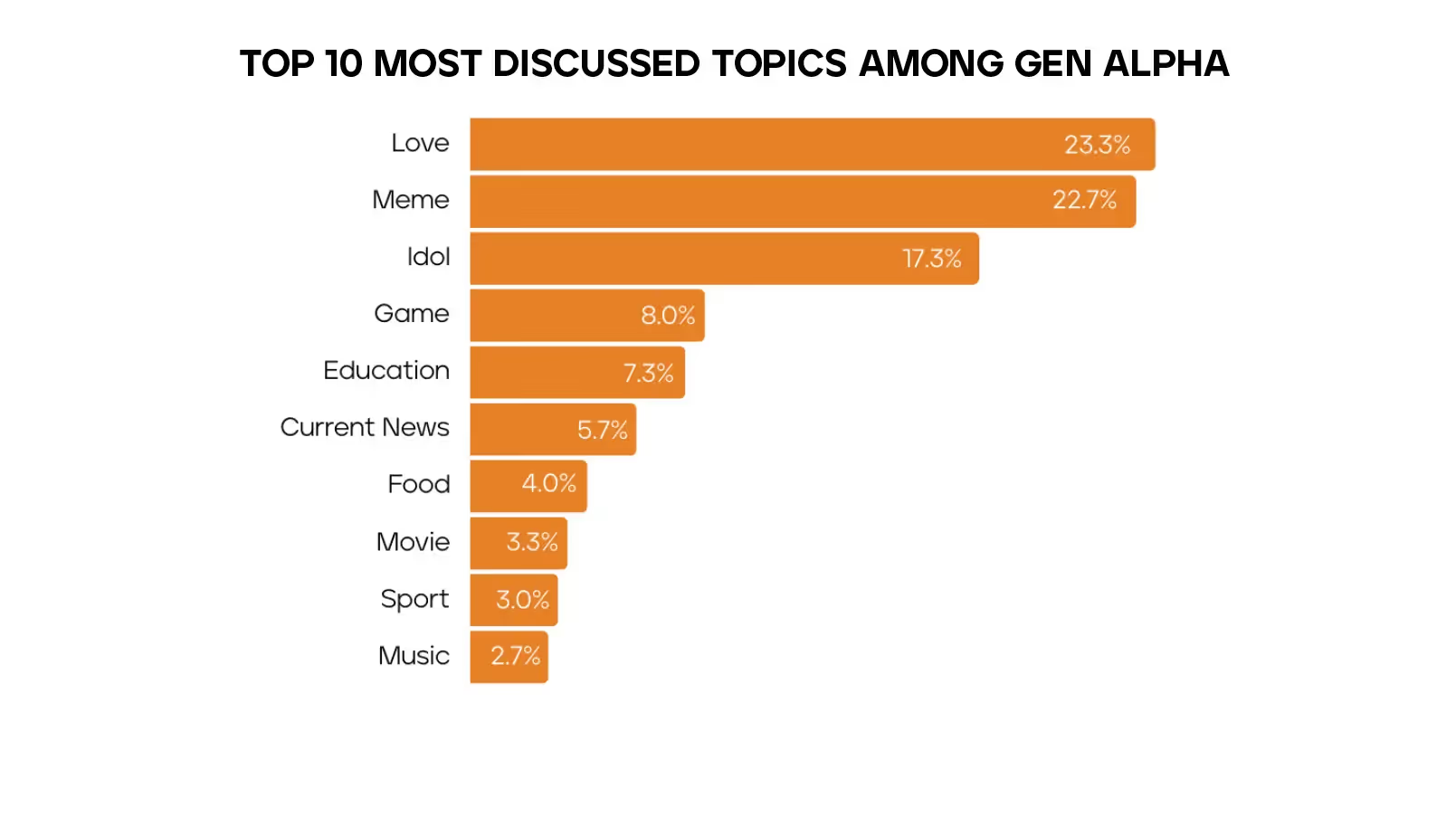
→ Read more: Gen Alpha: What Sets the Next Generation of Consumers Apart?
Notably, social media is segmented by interests. Therefore, identifying user groups and their main concerns is crucial in segmenting the social media audience. Pinpointing key interests and insights will help brands align their marketing tactics with user interests. As a result, branded content and messaging are more likely to appear in users' feeds, capturing attention, generating engagement, fostering recall and affinity, or even leading to user-generated content (UGC) related to the brand.
Social Listening supports marketers in planning, creating content, and adjusting strategies in real time throughout all phases of a campaign. It helps track brand sentiment and ensures campaigns align with audience expectations.
Today, even a small complaint on Facebook can cause significant damage to a brand. As consumers become increasingly familiar with social media, the likelihood of crises occurring rises. Our Social Listening data shows that while the number of crises has decreased as brands take a more proactive role in crisis management, the average scale of a crisis has grown significantly.
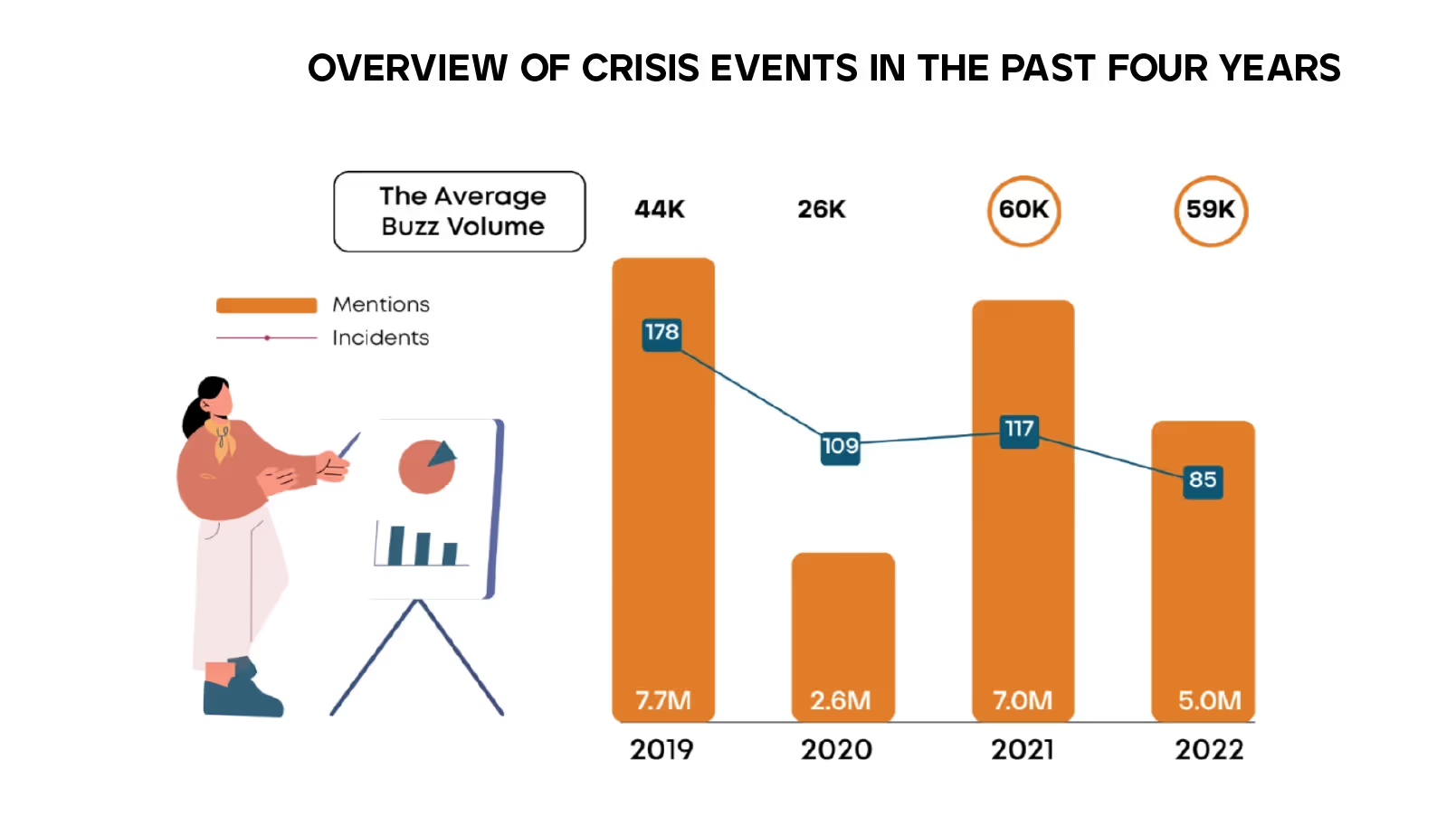
Crises may seem to occur randomly and can impact any brand for seemingly arbitrary reasons. This makes social media crises difficult to track and challenging for brands to respond to. However, through Social Listening, not only can crises be monitored, but their patterns can also be identified, allowing brands to develop strategic response plans.
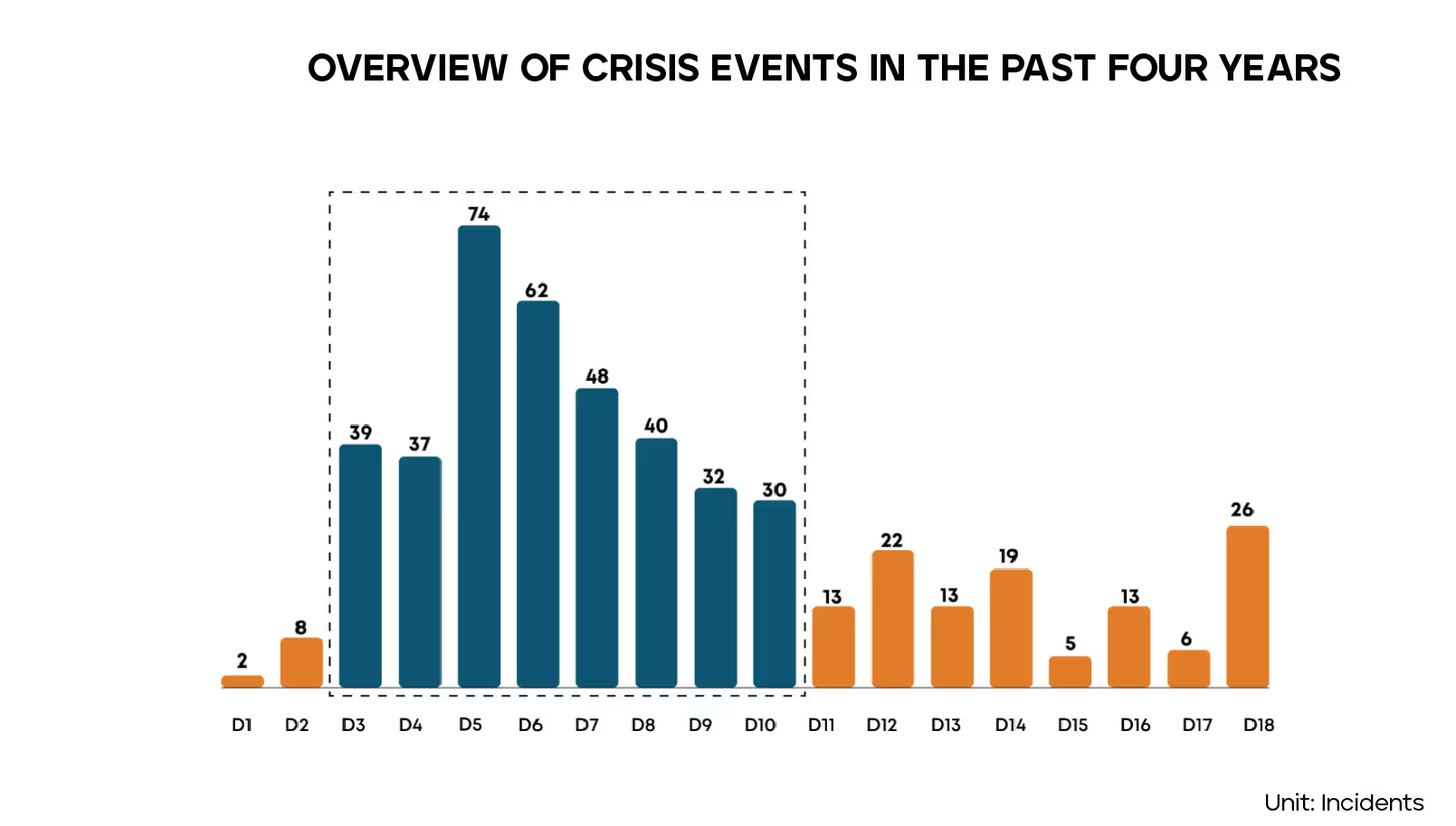
By analyzing user discussions on social media and providing actionable insights to brands, Social Listening plays a critical role in shaping communication strategies. The most common applications of Social Listening include gathering insights, tracking campaign performance, and managing crises.
To learn more about metrics, marketers can refer to here