

Viet Nam Housing Market 2025: Decoding the Role of Social Media and the Real Buyer Journey Through Online Discussions

Buzzmetrics’ analysis of Vietnam’s 2025 housing market recorded more than 5 million discussions related to residential real estate in the first six months of the year. This volume indicates that homebuying demand is no longer in a wait-and-see phase; it has shifted into active exploration, comparison, and serious consideration. At the same time, macroeconomic data points to clear signs of recovery: H1 GDP growth reached 7.52%, Q2/2025 transactions increased by more than 20% YoY, and both housing supply and newly approved projects continued to rise. The market is no longer driven by short-term investment expectations, but by genuine end-user demand - especially among young families and first-time buyers.
This article explores three key themes:
- Market context & supporting policies – What brought real buyers back?
- Social media landscape of the housing market – How social platforms shape perception and decisions.
- Case study: The Felix – A social-first campaign designed around the 2025 buyer journey.
➜ For the full dataset, segment-level insights, and how a project like The Felix leverages these signals to improve conversion, refer to the [Báo cáo thị trường nhà ở 2025 – Full Report].
01. Context & Supporting Policies: What Brings Real Buyers Back to the Market?
1.1. Economic recovery and shifting growth drivers
The first half of 2025 recorded 7.52% GDP growth - the highest in 14 years - alongside simultaneous improvements in housing supply, transaction volume, and newly licensed projects. These indicators show not only a warming market but also the return of genuine end-user demand.
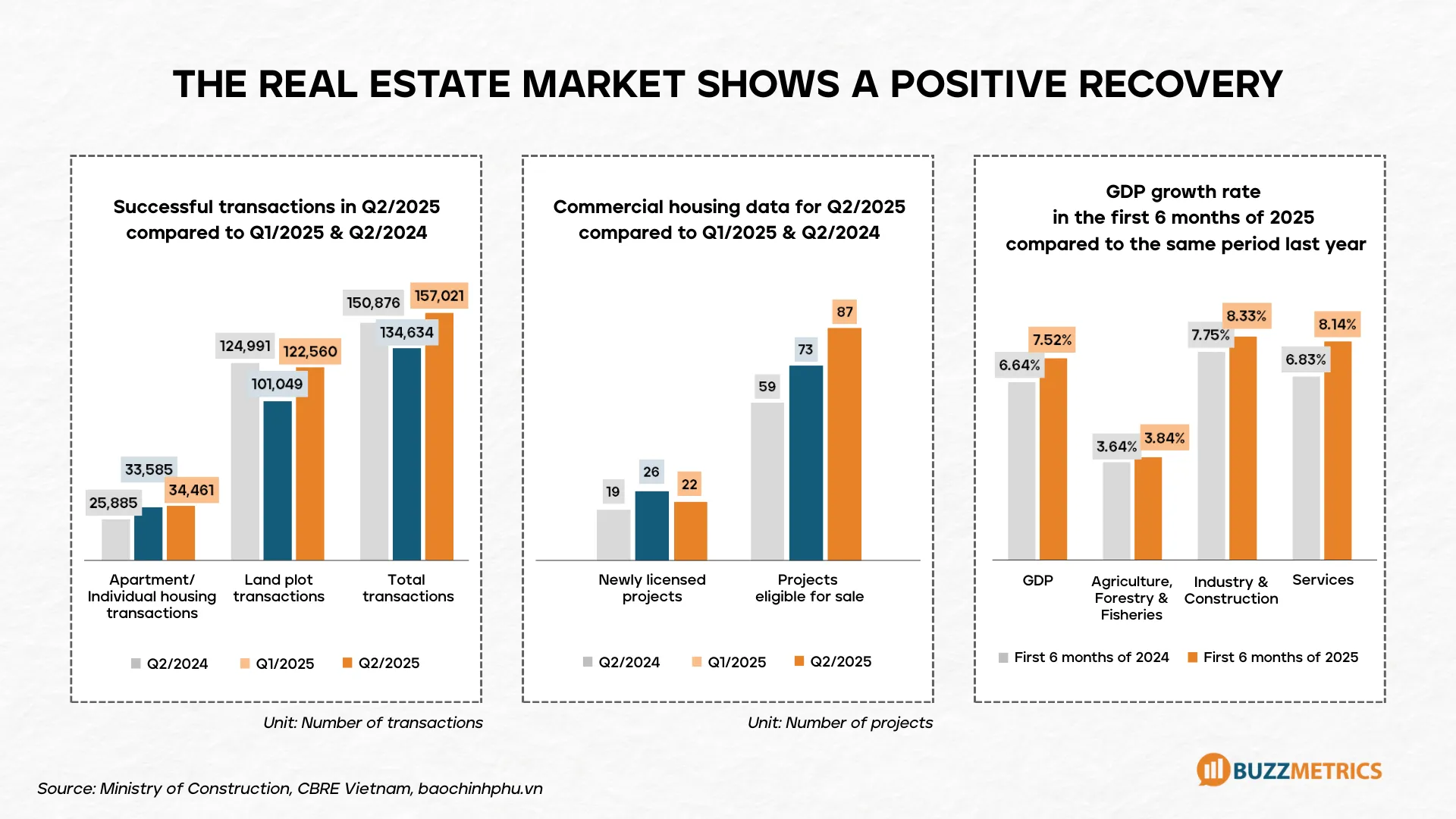
Buyer sentiment data reveals that 64% enter the market to live in, while only 36% buy for investment. The three best-performing property types - land plots (33%), apartments (30%), and private houses (21%) - are all closely tied to the need for stable living. Over the next 12 months, apartments and private houses continue to lead interest (31%), showing a shift toward long-term residence rather than short-term speculation.
1.2. The direct impact of interest rates, credit packages, and tax policies
Since early 2025, three financial policies were loosened simultaneously, quickly reshaping how buyers evaluate affordability:
- Mortgage interest rates decreased by 1.5–2 percentage points: Significantly reducing repayment pressure for loans of 1–2 billion VND over 15–25 years, prompting many families to reassess their cash flow and whether buying a home is now feasible.
- The 120,000-billion VND housing credit package began disbursement: Creating more opportunities for real buyers, particularly first-time homeowners. Online discussions focus on eligibility, loan limits, and qualifying projects - showing active user assessment of access to incentives.
- VAT at 8% maintained: Directly affecting final payment costs for mid-range apartments. The tens of millions of VND difference between 8% and 10% VAT drives buyers to scrutinize price lists and calculation methods across projects.
On social media, these policies are not discussed as macroeconomic updates, but transformed into personal financial equations: “How much do I pay monthly?”, “How does lower interest affect total repayment?”, “Which project truly applies incentives?”
The pace of discussion shows buyers are no longer observing the market from afar; they are actively checking whether new incentives open the door for them to enter.
1.3. Land Law updates & new urban planning: A window for the mid-range segment
Adjustments to the Land Law, Housing Law, and the reclassification of merged urban areas are creating new development axes for satellite regions - especially attractive for the mid-range segment (≤ 3 billion VND). Buyers are willing to move farther from the center in exchange for clear legal frameworks, improved infrastructure, and long-term value.
In discussions, buyers focus heavily on areas newly rezoned or proposed to become new urban centers. They no longer view planning as a signal for price growth but evaluate its effect on daily life: commute convenience, school routes, and the potential for a stable residential community.
02. Social Media Landscape of the Housing Market
2.1. The 2025 housing market warms up - fueled by real demand
The first six months of 2025 recorded over 5 million discussions related to residential real estate. Conversations gradually increased and peaked at 281,000 mentions in early August - coinciding with intensified news about credit packages, legal updates, and provincial-city mergers.
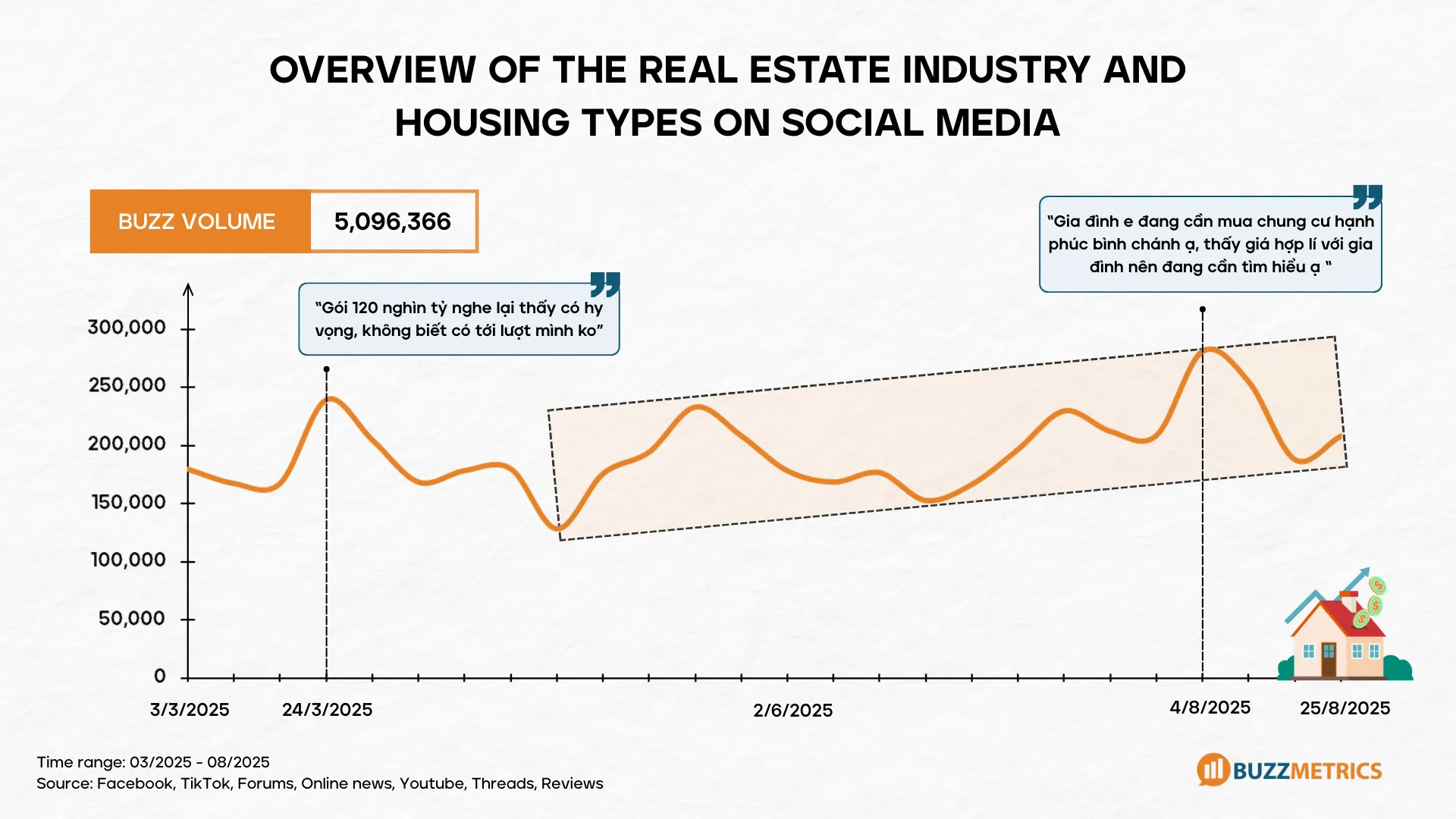
The key insight is not the volume, but the shift in discussion content. Buyers are moving from general observation to problem-solving behaviors tied to decision-making: safe loan structures, which policies actually apply, and whether new planning affects commute times or daily convenience. Housing consideration is being shaped by foundational factors: loan capacity, legal clarity, and urban structure - not speculative price expectations.
Beyond typical topics like price, location, and legal status, new discussion themes emerged: comparing bank interest rates, optimizing loan packages, and weighing pros/cons between mid-range apartments and suburban land plots.
2.2. Facebook & TikTok: Two critical touchpoints in the homebuying journey
Facebook (84.4%) and TikTok (14.4%) dominate conversations, each taking on distinct roles:
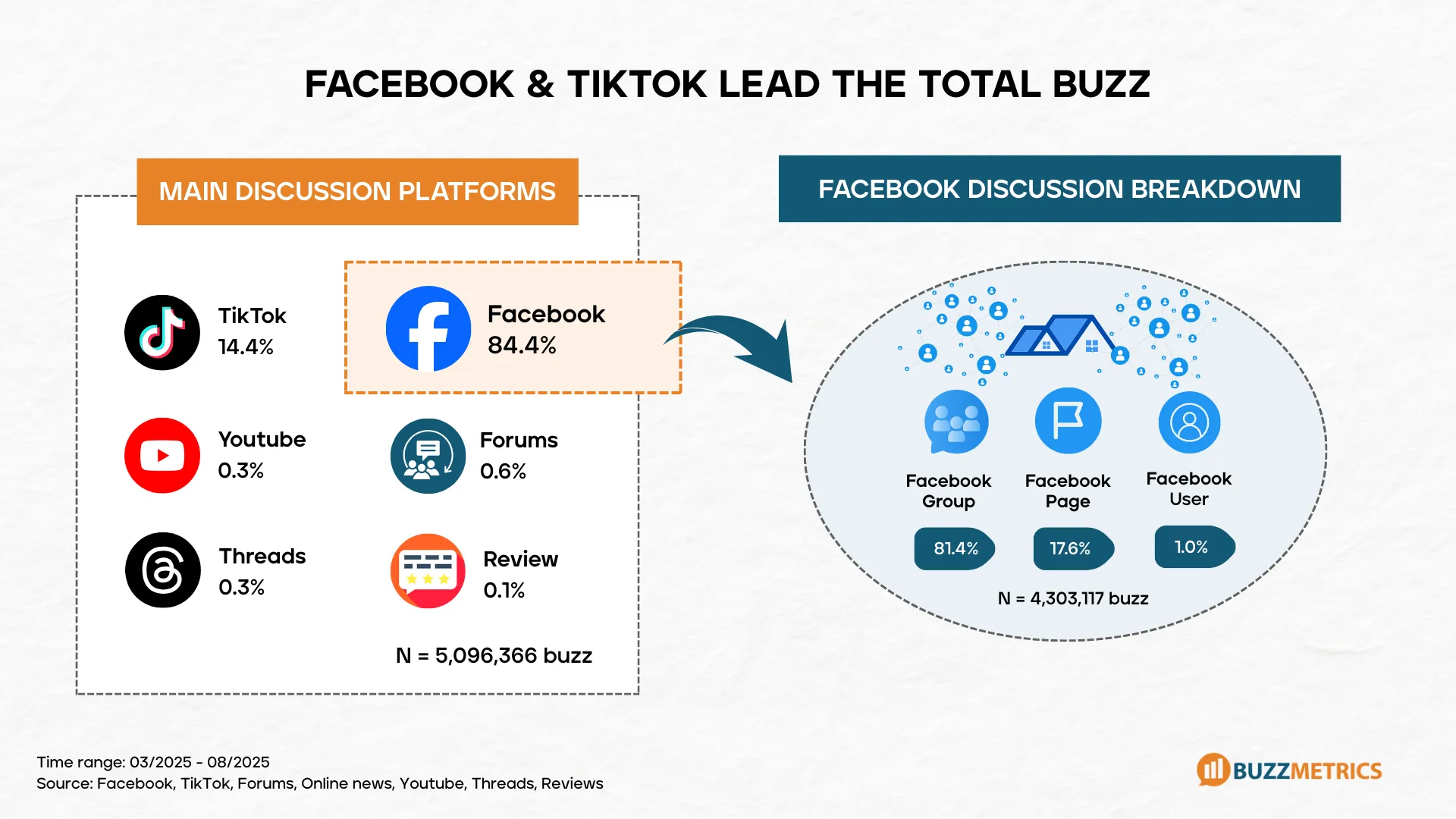
Facebook functions as an ecosystem where buyers ask questions rarely addressed by official channels: handover quality, hidden fees, management responsiveness, safety, or resident conflicts. These real experiences shape expectations and directly influence which projects earn trust or are excluded.
On the contrary, TikTok becomes a “virtual property tour,” where users verify what they’ve heard through visuals: construction progress, landscaping, resident density, mobility experience, and overall liveability. Together, these platforms not only reflect demand but actively shape each step in the buyer’s decision-making process.
2.3. Portrait of user groups driving the housing market
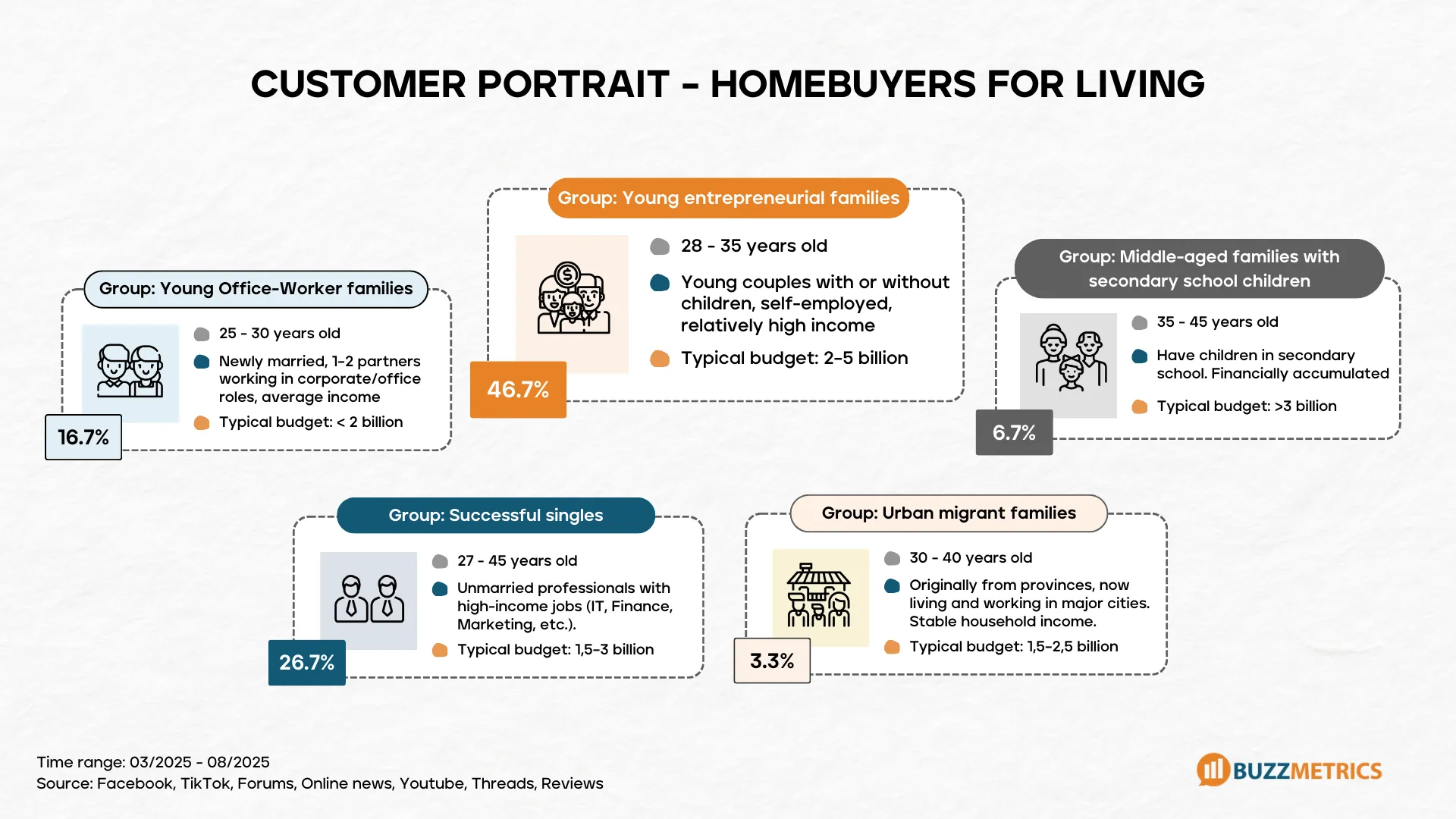
Although brokers still dominate discussions (75.1%), a noteworthy shift is the rise of authentic voices: real buyers and current residents now account for over 20% - the highest in three years. This group is the most trusted, as they reflect lived experience rather than sales-driven narratives.
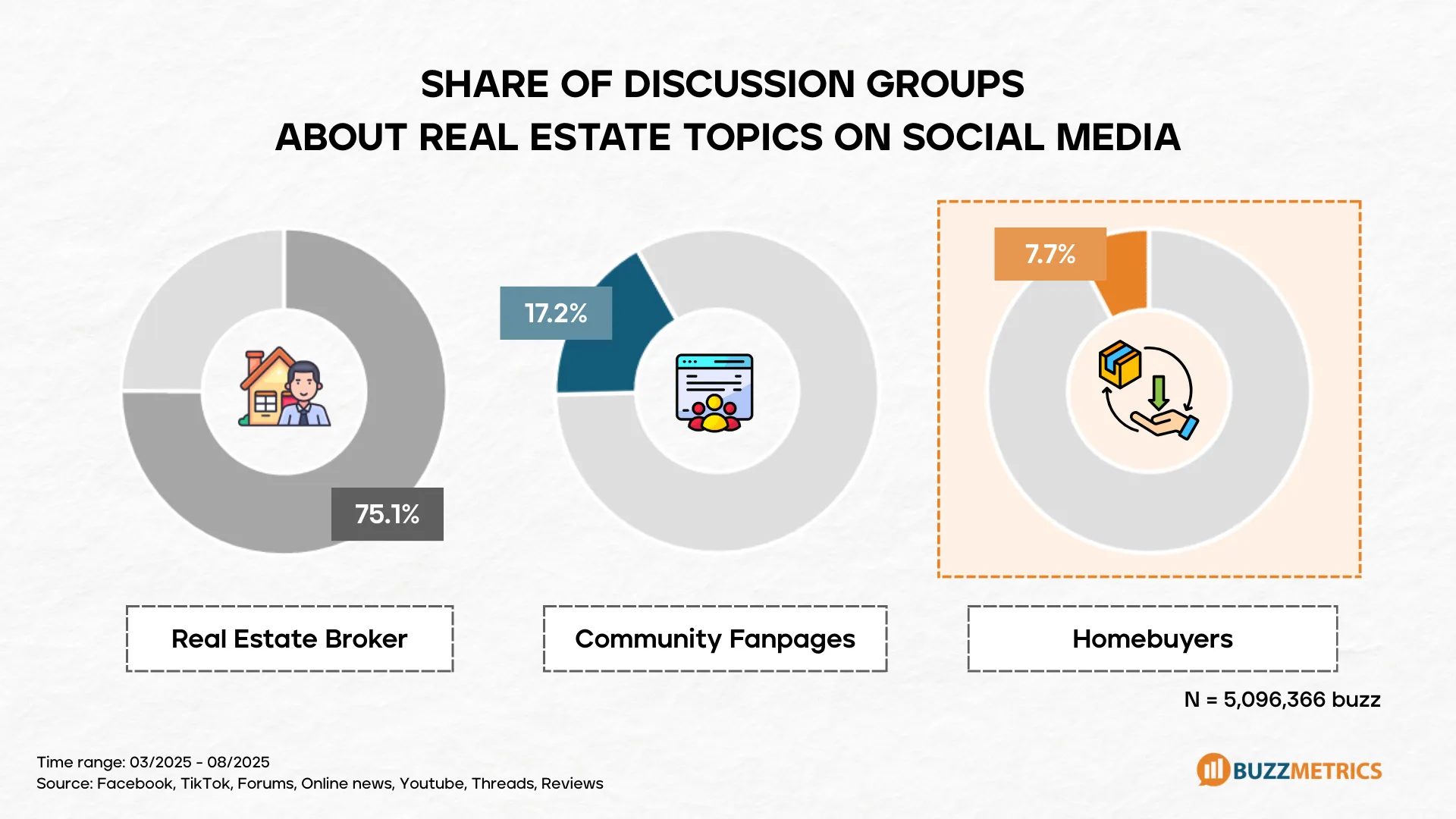
Leading much of the conversation are financially capable young adults - especially small-business families and successful singles aged 23–35. Their budgets center around 2–5 billion VND, aligning with urban living needs and early asset-building goals. A consistent trait of this group is their daily reliance on social media and preference for community validation over broker advice.
2.4. The homebuying journey on social media: Where social acts as the filter
Behavioral data shows social media is not just a reference channel but the primary space where buyers form nearly their entire decision, especially during two stages: Information Search and Infomation Ask & Sharing. By 2025, most buyers only meet brokers or visit show units after forming a “preliminary conclusion” on social - a shift not common in previous years.
.webp)
➤ Stage 1 – Information Search: Setting criteria and eliminating early risks
Over 49% of discussions occur in the first stage, showing that buyers turn to social media to establish basic criteria: reasonable price, suitable location, secure legal status, and reliable developers. This is when they start identifying which options are feasible and which risks should be avoided.
The importance of this stage lies not in the amount of information gathered, but in the ability to narrow down choices. When legal risks, slow progress, or unaffordable prices are detected early in discussions, buyers immediately eliminate those projects - helping the journey focus faster.
This initial filtering lays the foundation for the next stage. Once a shortlist is created, buyers begin asking more personalized questions.
➤ Stage 2 – Consideration: Personalized questions that determine the final shortlist
This stage accounts for the largest share of discussion (49.6%) and is when buyers reveal their true needs. Conversations shift from general information to project-specific questions: Is the commute feasible during rush hours? Does the unit layout fit a family of 3–4? Are management fees stable? How is the current resident community?
If the Information Search stage filters out unsuitable projects, the Consideration stage filters to find the most suitable ones.
➤ Stage 3 – Experience: Visiting show units to validate assumptions
Although only 0.4% of discussions happen at this stage, it serves as a validation rather than an exploration phase. Buyers visit show units to verify the information they’ve collected from social media over the first two stages. Observations - lighting, hallway conditions, finishing quality, and facility operations - are compared against resident feedback, video reviews, and group discussions. If the actual experience aligns with social media insights, the project is added to the final selection. Significant mismatches, however, lead to immediate rejection.
➤ Stage 4 – Decision: The final step shaped entirely by earlier social influence
Only 0.6% of discussions occur at the purchase stage, reflecting that the decision is almost entirely shaped in the first two stages. At this point, buyers merely complete the paperwork; the project choice is no longer reconsidered. Social media has already done its job - building trust, narrowing options, and leading buyers to the final decision.
Conclusion:
Observing the full discussion journey on social media, several key signals are reshaping how buyers approach the market:
- High user interest in real estate: Although agents still dominate discussions, recent legal adjustments have significantly increased discussions from actual homebuyers.
- Young families are a key potential segment: Most participants are aged 23–35, primarily young couples in the early career stage, with business income, seeking stable housing with a budget of 2–5 billion VND.
- The first two stages determine the entire journey: Buyers concentrate discussions on information search and project comparison, making this an ideal moment for brands to engage and connect early with potential customers.
- Platform shift across stages: Users often start on Facebook for information search, then move to TikTok for consideration and additional insights before deciding. Brands should allocate each channel strategically to maximize connection efficiency.
Discussion data in 2025 shows that actual housing demand is driving the market, and social media has become a decisive touchpoint in the homebuying journey. Contact Buzzmetrics to access the full report and deeper analysis of buyer behavior on social platforms.
Article Information





_11zon.webp)
.webp)




_11zon.avif)