
Social-First: When social media becomes the center of a marketing strategy
For many years, social media was often seen simply as a communication channel—a place where brands distributed content or launched campaigns to increase awareness. However, as consumer behavior becomes increasingly tied to social platforms, the way brands understand and engage with the market is also changing. Conversations on social media today almost instantly reflect how consumers think, feel, and respond to brands. From needs and emotions to emerging trend signals, everything is expressed through the daily discussions taking place on social media. In this context, many marketers are beginning to adopt a Social-First approach—placing social media at the center of their marketing strategy.
I. What is Social-First?
With a Social-First approach, social media is no longer just a communication channel—it becomes the infrastructure of marketing activities, a new kind of “operating system” for how brands run their strategies.
In this model, every interaction between brands and consumers is reflected through real-time conversations on social media. These discussions not only help brands understand how users perceive their products, but also provide critical signals about market needs and expectations, the topics gaining attention, and emerging trends.
As a result, social data is no longer used solely for communication purposes; it becomes a strategic source of insight, enabling brands to make more accurate and timely marketing decisions.
II. Why is Social-First becoming a new direction in marketing?
1. Social platforms are becoming an “information ecosystem”
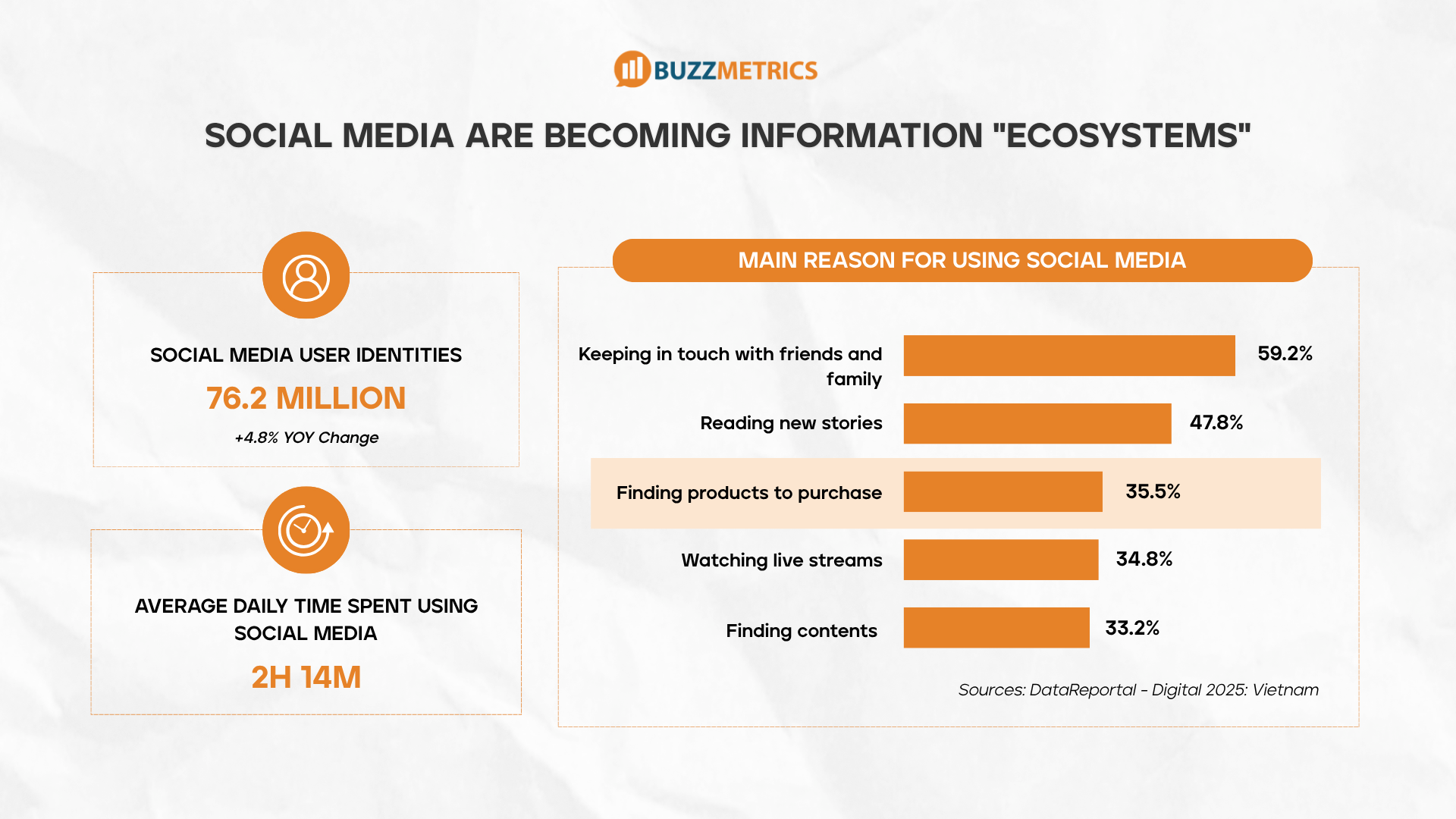
According to the Digital 2025 Vietnam report, Vietnam currently has 76.2 million social media users, with an average usage time of 2 hours and 14 minutes per day. Notably, 35.5% of users say they use social media to search for products before making a purchase. This reflects an important shift: social media is no longer just a place for content consumption—it has become a critical touchpoint throughout the entire customer journey.
In this context, a brand’s presence on social platforms is not only about maximizing reach, but also directly influences how consumers form perceptions and evaluate their choices.
2. Changing consumer behavior – Purchase decisions are increasingly shaped by community interactions
In the social media environment, purchase decisions are no longer formed entirely at an individual level. Consumers increasingly seek opinions, follow others’ experiences, and are influenced by public discussions before making their final choice.
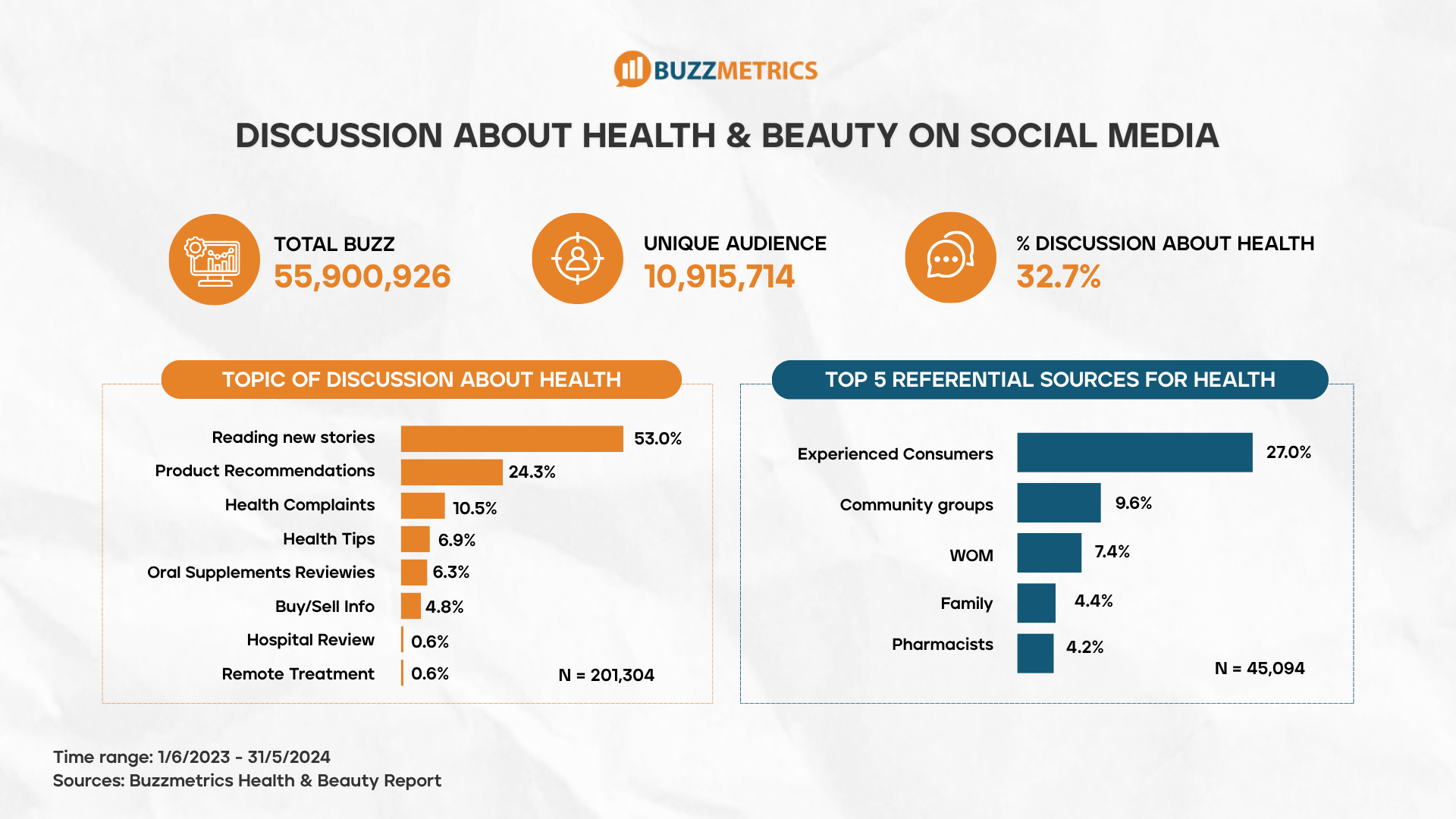
This trend is clearly reflected in a Health & Beauty industry report by Buzzmetrics. Over the course of a year, the industry recorded 55.9 million discussions and 10.9 million participants—showing that social media is not just a place to talk about products, but a space where consumers actively exchange needs and experiences.
Notably, among health-related discussions, 53% revolve around symptoms and solutions, while 24.3% focus on product recommendations. This indicates that decision-making is no longer purely individual, but gradually shaped through asking, comparing, and referencing community opinions.
This reality is further reinforced by the fact that the most trusted sources are people with real-life experience (27%), significantly outweighing professional or expert sources. In the social environment, community-driven experiences play a decisive role in shaping consumers’ final choices.
3. Market signals are shifting from “research-based” to “conversation-based”
If brands once relied mainly on periodic market research to understand consumers, today social media conversations have become a continuous stream of market signals. These discussions allow brands to observe how needs, expectations, and trends are forming and evolving in real time—rather than capturing just a static snapshot of the market at a single point in time.
III. How does Social-First change the way marketing operates?
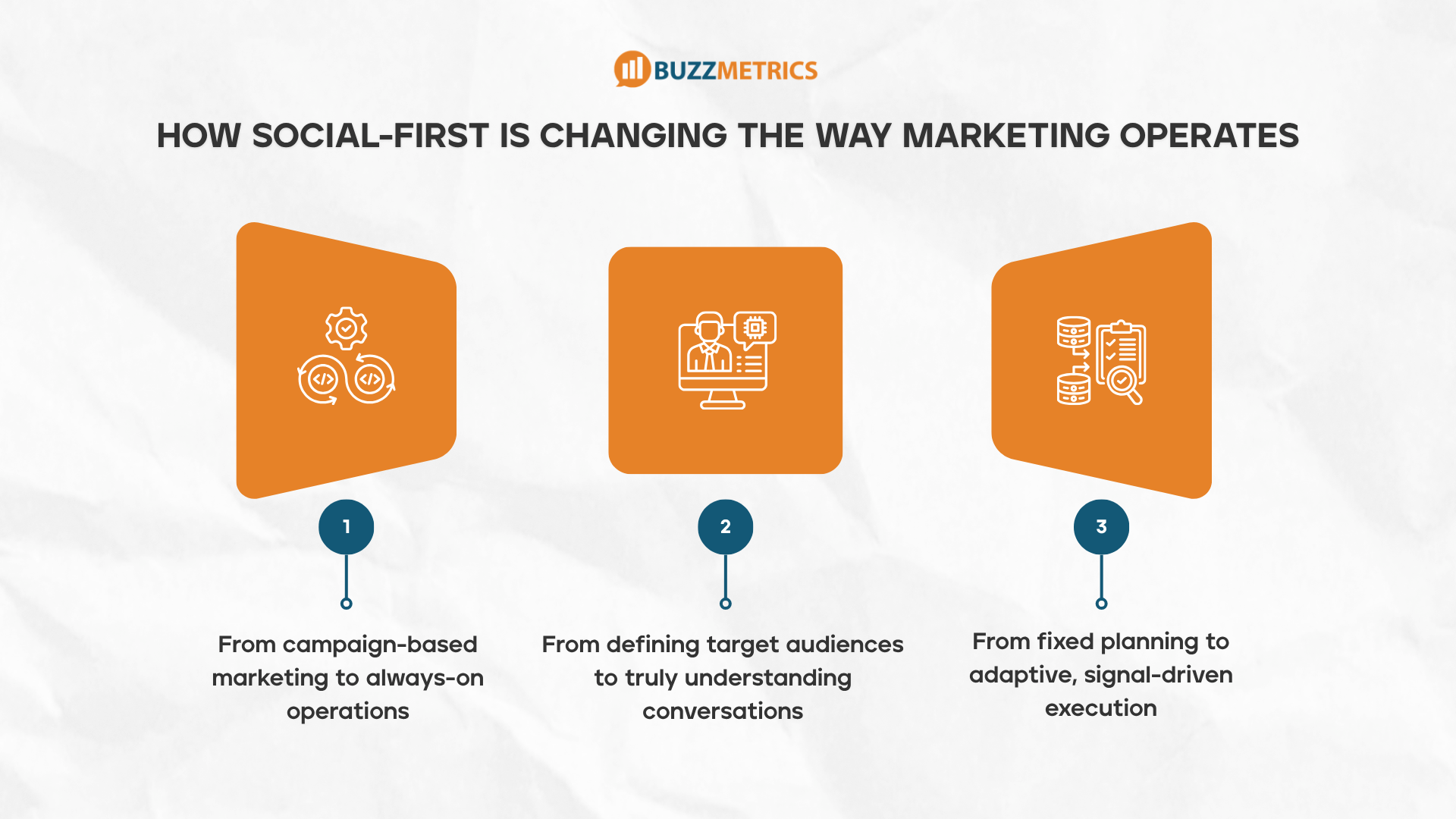
1. From campaign-based marketing to continuous operations
In traditional models, marketing is executed in distinct campaigns with clear lifecycles: planning, execution, measurement, and closure. In a Social-First environment, however, market signals emerge daily through ongoing consumer conversations on platforms like TikTok and Facebook. As a result, marketing is no longer a series of separate phases—it becomes a continuous operating system, where content, messaging, and activities are constantly refined based on real-time market feedback.
2. From defining target audiences to understanding conversations
Previously, marketing focused on identifying the right target audience and crafting messages tailored to that group. In the social era, the key question is no longer just “who is the customer?” but also “what are they talking about?”
Social conversations reveal what consumers care about, what they debate, and which narratives shape their perception of brands. Marketing, therefore, shifts from targeting the right audience to understanding the right conversation context.
3. From fixed planning to adaptive execution
As consumer needs and expectations evolve in real time, rigid, months-long marketing plans become less effective. Instead, brands must continuously track market signals and adjust content, messaging, and execution in response to actual user reactions. In a Social-First context, marketing is no longer just about building plans—it’s about the ability to adapt quickly to ongoing changes in the market.
IV. What do brands need to change?
The shift to Social-First isn’t just about communication—it requires brands to rethink how marketing operates at a system level.
First, elevate social media research to a decision-making foundation. Social listening is no longer a supporting tool; it becomes the starting point for strategy. Platforms like TikTok and Facebook continuously reflect consumer thoughts, needs, and expectations. Tracking and analyzing these signals is essential for understanding the market and responding in time.
Second, treat content as a continuous system—not a campaign output. Content is no longer something you “produce and publish” once. It becomes an ongoing cycle of creation, testing, and optimization, shaped by real user feedback rather than fixed plans.
Third, turn insight into real-time input for action. Insight is no longer a retrospective report. Its value lies in helping brands detect early shifts in consumer behavior and perception—so they can adjust strategy and execution proactively, not reactively.
V. Measurement challenges when social becomes the center
As social media takes on a bigger role in shaping consumer decisions, a gap in how marketing effectiveness is measured begins to surface. Today, many brands still rely on familiar metrics like buzz, engagement, and reach—often gathered from platforms such as Facebook or TikTok. These indicators reflect how active a campaign is, but they don’t fully capture the real impact social has on the brand. In reality, not every conversation drives decisions, not every interaction changes perception, and high visibility doesn’t necessarily translate into meaningful influence. This creates a common risk: brands may achieve strong-looking numbers on social media while failing to generate actual shifts in consumer behavior or mindset. This is often referred to as “vanity metrics”—surface-level indicators that suggest success, but don’t truly reflect marketing effectiveness.
In a Social-First world, the challenge is no longer just measuring activity, but understanding impact: Are conversations changing how people feel? Are they influencing consideration and choice? Without answering these deeper questions, brands risk optimizing for noise instead of value.
.png)
Conclusion
Social-First signals a fundamental shift in marketing: social media is no longer just a communication channel, but a central source of market signals—where consumer needs, perceptions, and decisions are shaped through ongoing conversations on platforms like TikTok and Facebook.
As marketing evolves into a continuous, signal-driven system, measurement frameworks must evolve accordingly. Relying solely on familiar metrics such as buzz, engagement, or reach makes it difficult for brands to fully understand the real impact of social media on shaping perception and influencing behavior.
This raises a critical question: if social media plays a role in forming decisions, how can its true impact on brands be accurately measured?
That is precisely why new measurement approaches and operating models like Marketing Systems OS are becoming essential—helping brands systematically connect conversation data with metrics of perception and behavior.
If your business is looking to better understand the impact of social media on brand and business performance, consider reaching out to the team at Buzzmetrics for tailored consulting on analysis and measurement solutions.
Article Information




.png)
_11zon.webp)